
Cloud infrastructure is becoming increasingly complex. Organizations now manage containers, Kubernetes clusters, virtual networks, databases, identity services, AI workloads, and multi-cloud environments. Manually configuring these resources through cloud portals is difficult to scale and can introduce configuration inconsistencies.
Infrastructure as Code (IaC) solves this problem by allowing teams to define infrastructure through version-controlled, repeatable code. In 2026, Terraform, Microsoft Bicep, and Pulumi are three important IaC options, but they approach infrastructure management differently.
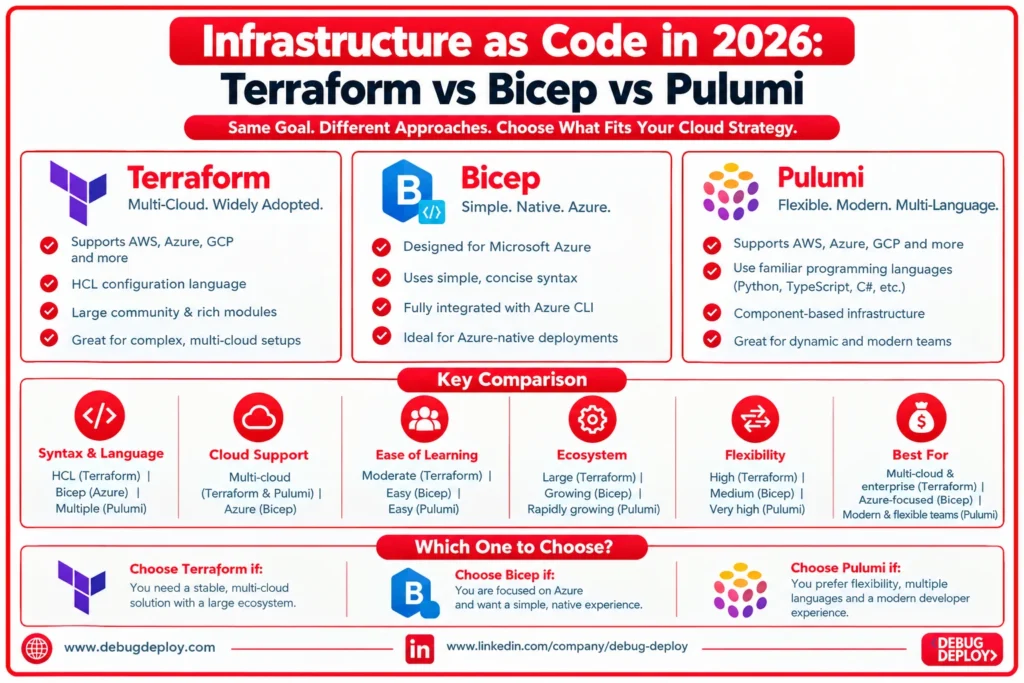
Terraform uses HashiCorp Configuration Language (HCL) and supports a broad provider ecosystem. Bicep is Microsoft’s declarative language designed specifically for Azure. Pulumi allows infrastructure to be defined using general-purpose programming languages such as TypeScript, Python, Go, C#, and Java, alongside YAML and HCL.
What Is Infrastructure as Code?
Infrastructure as Code is the practice of provisioning and managing infrastructure through machine-readable definitions instead of manually configuring resources.
With IaC, infrastructure can be:
Stored in Git
Reviewed through pull requests
Version controlled
Tested before deployment
Reused across environments
Integrated into CI/CD pipelines
Recreated consistently
For example, instead of manually creating an Azure virtual network, subnet, storage account, and virtual machine, an engineering team can define the desired infrastructure in code and deploy it repeatedly.
This approach supports modern DevOps, DevSecOps, cloud engineering, platform engineering, and cloud migration strategies.
Terraform vs Bicep vs Pulumi: At a Glance
Feature | Terraform | Bicep | Pulumi |
Primary focus | Multi-cloud and infrastructure | Azure | Multi-cloud and infrastructure |
Language | HCL | Bicep DSL | TypeScript, Python, Go, C#, Java, YAML, HCL |
Cloud coverage | Broad provider ecosystem | Azure | Multi-cloud |
State model | Terraform state | Azure incremental deployment | Pulumi state |
Azure integration | Strong | Native | Strong |
Abstraction | Modules | Modules | Programming-language abstractions |
Learning style | IaC-specific language | Azure-focused DSL | General-purpose programming |
Multi-cloud | Yes | No | Yes |
CI/CD integration | Strong | Strong | Strong |
Best suited to | Multi-cloud infrastructure teams | Azure-centric teams | Developer-oriented IaC teams |
Microsoft describes Terraform as a general-purpose IaC option, while Bicep is designed for Azure-related infrastructure.
Terraform in 2026
Terraform is a widely used infrastructure-as-code platform for building, changing, and versioning infrastructure. It uses HashiCorp Configuration Language (HCL) and relies on providers to interact with cloud platforms, SaaS services, and other APIs.
Terraform’s provider model is one of its central capabilities. Providers allow Terraform to manage resources across different platforms, with the Terraform Registry providing access to providers maintained by HashiCorp, partners, and the wider community.
Terraform strengths
Broad multi-cloud support
Mature module and provider ecosystem
Declarative configuration
Infrastructure state management
Strong CI/CD compatibility
Suitable for hybrid and multi-cloud environments
Reusable modules for standard infrastructure patterns
Terraform can be particularly useful when an organization needs to manage Azure, AWS, Google Cloud, Kubernetes, SaaS platforms, and other infrastructure through a consistent IaC workflow.
Terraform considerations
Teams need to understand Terraform state, provider versions, modules, dependencies, and state security. State should be appropriately protected because it can contain important infrastructure information. Microsoft specifically highlights Terraform’s use of state to map real-world resources to configuration.
Bicep in 2026
Bicep is Microsoft’s domain-specific language for declaratively deploying Azure resources. It provides an alternative to writing Azure Resource Manager templates directly in JSON and is designed to provide a concise authoring experience for Azure infrastructure.
Bicep is tightly integrated with Azure Resource Manager, making it particularly relevant for organizations whose infrastructure is primarily Microsoft Azure.
Bicep strengths
Azure-native infrastructure deployment
Concise syntax compared with ARM JSON
Strong Azure resource integration
Type safety
Reusable modules
Microsoft tooling and documentation
Good fit for Azure landing zones and platform engineering
One important architectural difference is that Bicep does not maintain a Terraform-style state file. Microsoft documents Bicep as using incremental deployment to determine and apply infrastructure changes.
Bicep considerations
The major consideration is scope. Bicep is designed for Azure and is not intended to provide the same multi-cloud abstraction as Terraform or Pulumi.
For an Azure-only environment, however, its close relationship with Azure Resource Manager can simplify infrastructure management.
Pulumi in 2026
Pulumi takes a different approach to infrastructure as code by allowing teams to use familiar programming languages.
Pulumi currently supports languages including TypeScript, JavaScript, Python, Go, C#, .NET, Java, YAML, and HCL.
Instead of learning a dedicated configuration language, developers can use familiar programming concepts such as functions, loops, classes, packages, and language-native testing tools.
Pulumi strengths
General-purpose programming languages
Multi-cloud infrastructure management
Strong developer experience
Reusable software abstractions
Testing capabilities
Support for AWS, Azure, Google Cloud, Kubernetes, and other providers
Useful for teams with strong software engineering backgrounds
Pulumi describes its platform as supporting infrastructure across major clouds and Kubernetes while providing multiple language options.
Pulumi considerations
Teams need to be comfortable treating infrastructure as software. That flexibility can be powerful, but it can also introduce additional programming complexity if infrastructure code becomes overly abstract.
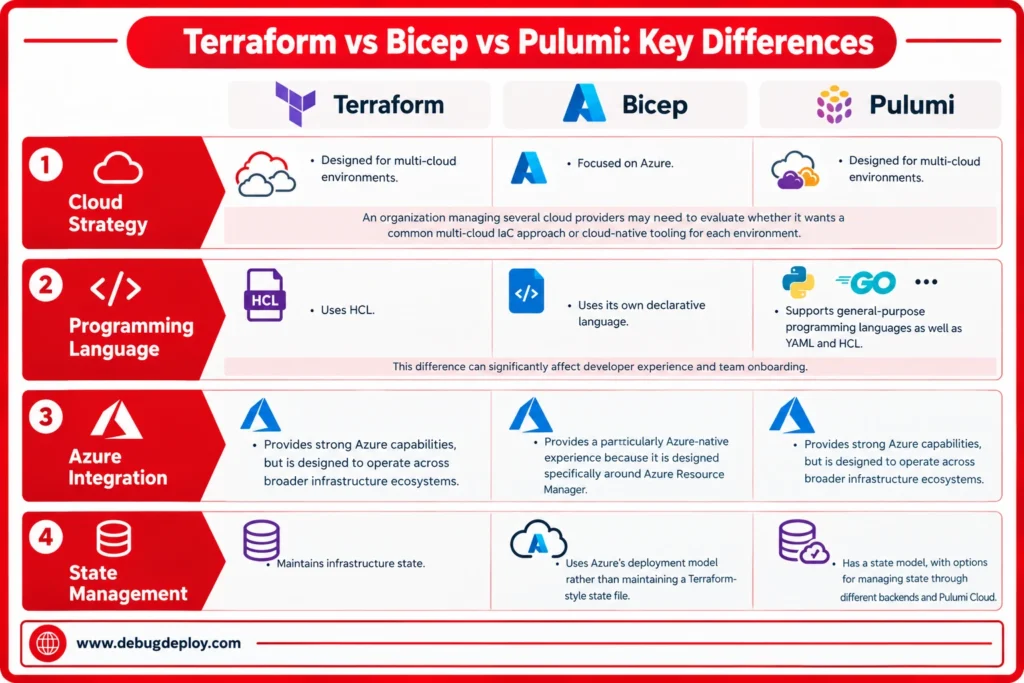
Terraform vs Bicep vs Pulumi: Key Differences
1. Cloud Strategy
Terraform and Pulumi are designed for multi-cloud environments.
Bicep is focused on Azure.
Therefore, an organization managing several cloud providers may need to evaluate whether it wants a common multi-cloud IaC approach or cloud-native tooling for each environment.
2. Programming Language
Terraform uses HCL.
Bicep uses its own declarative language.
Pulumi supports general-purpose programming languages as well as YAML and HCL.
This difference can significantly affect developer experience and team onboarding.
3. Azure Integration
Bicep provides a particularly Azure-native experience because it is designed specifically around Azure Resource Manager.
Terraform and Pulumi also provide strong Azure capabilities, but they are designed to operate across broader infrastructure ecosystems.
4. State Management
Terraform maintains infrastructure state.
Bicep uses Azure’s deployment model rather than maintaining a Terraform-style state file.
Pulumi also has a state model, with options for managing state through different backends and Pulumi Cloud.
Which IaC Tool Fits Your Environment?
The decision should start with your infrastructure requirements rather than the tool itself.
Consider Terraform when:
You manage multiple cloud providers
You want a broad provider ecosystem
Your team already has Terraform expertise
You need reusable infrastructure modules
You want a standardized IaC workflow across different platforms
Consider Bicep when:
Azure is your primary cloud
You want Azure-native infrastructure definitions
Your team works heavily with Azure Resource Manager
You want concise Azure infrastructure code
Your architecture is primarily Microsoft-based
Consider Pulumi when:
Developers prefer general-purpose programming languages
You need multi-cloud infrastructure
You want infrastructure abstractions using familiar programming concepts
Testing infrastructure code is important
Your engineering team is comfortable with software development practices
IaC and DevOps in 2026
Infrastructure as Code is increasingly connected with CI/CD, GitOps, DevSecOps, Kubernetes, policy as code, and platform engineering.
A typical workflow can look like:
Developer → Git Repository → Pull Request → IaC Validation → Security Checks → Plan/Preview → Approval → Infrastructure Deployment → Monitoring
This workflow makes infrastructure changes more visible and repeatable.
Teams can also integrate IaC into automated security and compliance checks, helping identify misconfigurations before infrastructure reaches production.
Best Practices for Infrastructure as Code
Regardless of whether you choose Terraform, Bicep, or Pulumi, several practices remain important:
Store IaC in version control
Use reusable modules or components
Separate development, staging, and production environments
Protect infrastructure state and secrets
Use least-privilege access
Run validation and security checks in CI/CD
Review infrastructure changes through pull requests
Document infrastructure dependencies
Pin or control important provider/tool versions
Avoid unnecessary manual changes to managed infrastructure
The Future of Infrastructure as Code
In 2026, IaC is moving beyond simple resource provisioning.
Modern infrastructure teams are combining IaC with:
AI-assisted development
Platform engineering
GitOps
Policy as Code
DevSecOps
Kubernetes
Multi-cloud management
Infrastructure testing
Automated compliance
Self-service developer platforms
The growing use of AI coding assistants is also changing how engineers create and review infrastructure definitions. However, generated infrastructure code still needs validation, security review, testing, and appropriate human oversight.
Conclusion
Terraform, Bicep, and Pulumi all support Infrastructure as Code, but they target different infrastructure workflows.
Terraform provides a broad provider-based approach for multi-cloud and heterogeneous infrastructure. Bicep provides an Azure-focused declarative experience closely aligned with Azure Resource Manager. Pulumi brings general-purpose programming languages into infrastructure management and supports multi-cloud environments.
The practical choice depends on your cloud strategy, team skills, infrastructure complexity, governance requirements, and existing DevOps workflow.
For organizations modernizing cloud infrastructure in 2026, understanding these differences can help create a more repeatable, secure, and scalable infrastructure delivery process.
Want to Master Infrastructure as Code with Terraform, Bicep & Pulumi?
Learn how to design, automate, and manage cloud infrastructure using modern Infrastructure as Code (IaC) tools with guidance from a Microsoft Certified Trainer (MCT). Build practical skills across Terraform, Azure Bicep, Pulumi, cloud automation, and scalable infrastructure management.
Recommended Microsoft Azure, Cloud & DevOps Certification Programs:
AZ-204 – Developing Solutions for Microsoft Azure
AZ-104 – Microsoft Azure Administrator
AZ-305 – Designing Microsoft Azure Infrastructure Solutions
AZ-900 – Microsoft Azure Fundamentals
Live Instructor-Led Training
Infrastructure as Code (IaC) concepts and best practices
Terraform, Bicep & Pulumi fundamentals
Azure infrastructure automation and deployment
Cloud provisioning, configuration & resource management
DevOps, CI/CD and infrastructure automation
Real-world cloud architecture and deployment scenarios
Certification preparation and practical guidance
– Email: trainings@debugdeploy.com
– WhatsApp: Contact us for quick assistance
Build your Infrastructure as Code expertise and learn how to automate, deploy, and manage scalable cloud infrastructure using Terraform, Bicep, and Pulumi in 2026.