
Modern software teams are under constant pressure to build, test, deploy, and operate applications faster while maintaining security, reliability, and scalability. As cloud platforms, Kubernetes, Infrastructure as Code, and automation become standard parts of software delivery, organizations are also changing how development and operations teams work together.
Two terms frequently discussed in modern cloud-native environments are DevOps and Platform Engineering. Although they are closely related, they are not the same thing.
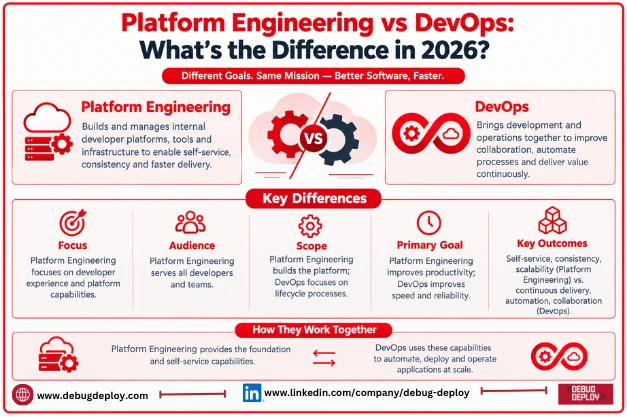
DevOps is a culture and operating approach that brings development and operations closer together, while Platform Engineering focuses on building internal platforms and self-service tools that make it easier for developers to deliver and operate applications.
Understanding the difference between Platform Engineering and DevOps can help organizations design better software delivery processes in 2026.
What Is DevOps?
DevOps is a combination of practices, collaboration, automation, and cultural principles designed to improve software development and IT operations.
Traditional development and operations teams often worked separately. Developers focused on writing application code, while operations teams were responsible for infrastructure, deployments, and production systems.
DevOps encourages these teams to work together throughout the software lifecycle.
A typical DevOps lifecycle includes:
Plan → Code → Build → Test → Release → Deploy → Operate → Monitor
Common DevOps practices include:
Continuous Integration (CI)
Continuous Delivery and Deployment (CD)
Infrastructure as Code
Automated testing
Cloud automation
Monitoring and observability
Collaboration between development and operations
The objective is to create a faster and more reliable software delivery process.
What Is Platform Engineering?
Platform Engineering is the practice of designing and maintaining internal platforms that provide developers with reusable tools, services, workflows, and infrastructure.
Instead of requiring every development team to understand all the details of Kubernetes, cloud networking, CI/CD, security, monitoring, and infrastructure provisioning, a platform team can provide standardized capabilities through an internal developer platform.
For example, developers might use a self-service portal to create a new application environment.
Behind the scenes, the platform could automatically configure:
Kubernetes resources
Cloud infrastructure
CI/CD pipelines
Monitoring
Logging
Security policies
Database services
DNS and networking
This allows developers to focus more on application development while the platform team manages the underlying engineering complexity.
Platform Engineering vs DevOps: Key Difference
The biggest difference is where the focus is placed.
DevOps focuses on collaboration and improving the overall software delivery lifecycle.
Platform Engineering focuses on creating an internal product or platform that provides developers with standardized self-service capabilities.
DevOps asks:
How can development and operations work together more effectively?
Platform Engineering asks:
How can we build a platform that makes the right development and operational processes easier to use?
These approaches are complementary rather than mutually exclusive.
Platform Engineering vs DevOps Comparison
Area | DevOps | Platform Engineering |
Primary focus | Software delivery and collaboration | Internal developer platforms |
Main users | Developers and operations teams | Developers and engineering teams |
Approach | Culture, practices, and automation | Product/platform development |
Infrastructure | Often managed collaboratively | Abstracted through platform services |
Self-service | May be available | Core capability |
Standardization | Encouraged | Strong focus |
Developer experience | Important | Central priority |
Automation | Core practice | Built into platform workflows |
Kubernetes | May be managed directly | Often abstracted through the platform |
Goal | Faster, reliable software delivery | Simplified and standardized developer workflows |
How Platform Engineering Builds on DevOps
Platform Engineering did not replace DevOps. Instead, it can be viewed as an evolution of several DevOps practices.
In a smaller organization, developers may work directly with cloud infrastructure and CI/CD systems.
As the organization grows, each development team may begin creating its own deployment pipelines, Kubernetes configurations, monitoring systems, and infrastructure.
This can create duplication and inconsistent processes.
A platform engineering team can centralize common capabilities and provide reusable services.
For example:
Development Team → Internal Developer Platform → Cloud/Kubernetes Infrastructure
The development team can request standardized infrastructure without manually managing every underlying component.
What Is an Internal Developer Platform?
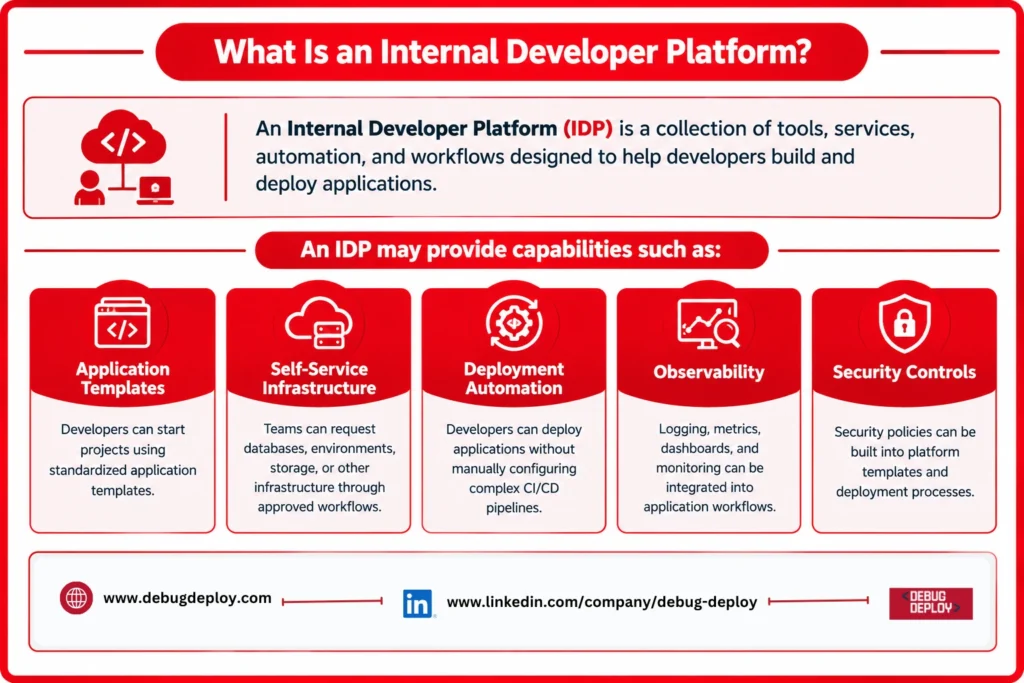
An Internal Developer Platform (IDP) is a collection of tools, services, automation, and workflows designed to help developers build and deploy applications.
An IDP may provide capabilities such as:
Application Templates
Developers can start projects using standardized application templates.
Self-Service Infrastructure
Teams can request databases, environments, storage, or other infrastructure through approved workflows.
Deployment Automation
Developers can deploy applications without manually configuring complex CI/CD pipelines.
Observability
Logging, metrics, dashboards, and monitoring can be integrated into application workflows.
Security Controls
Security policies can be built into platform templates and deployment processes.
The goal is not to hide everything from developers. Instead, the platform should provide a simpler interface for common tasks while allowing advanced teams to access lower-level capabilities when required.
Why Platform Engineering Is Growing in 2026
Cloud-native environments have become increasingly complex.
A modern application may involve:
Multiple cloud services
Kubernetes
Containers
CI/CD
Infrastructure as Code
APIs
Databases
Security tools
Observability platforms
AI services
Expecting every developer to become an expert in all these technologies can increase cognitive load.
Platform Engineering addresses this problem by creating a paved path for common development workflows.
Instead of asking developers to understand dozens of infrastructure tools, organizations can provide standardized workflows that automate many of the underlying tasks.
Platform Engineering and Kubernetes
Kubernetes is a common technology in platform engineering because it provides a flexible foundation for running cloud-native workloads.
However, Kubernetes itself can be complex.
A platform team can create abstractions that allow developers to deploy applications without manually managing every Kubernetes resource.
For example, instead of asking developers to write multiple Kubernetes manifests, a platform might provide a simple application template:
Application Name
Runtime
Environment
Database
Resources
Deployment
The platform can then generate or configure the required Kubernetes resources automatically.
This approach can improve consistency while reducing repetitive infrastructure work.
DevOps, Platform Engineering, and DevSecOps
These practices can work together.
DevOps establishes collaboration and automation across development and operations.
Platform Engineering provides reusable internal services and self-service workflows.
DevSecOps integrates security into development and deployment processes.
Together, they can create a modern software delivery model:
Developer → Internal Platform → CI/CD → Security → Cloud/Kubernetes → Observability
Security controls, policies, monitoring, and deployment standards can be incorporated directly into platform workflows.
Challenges of Platform Engineering
Platform Engineering also introduces new responsibilities.
A platform team must treat the internal platform as a product. Developers are its customers, so the platform needs good documentation, usability, reliability, and support.
Other challenges include:
Platform complexity
Poor developer adoption
Excessive abstraction
Lack of documentation
Platform maintenance
Tool sprawl
Difficulty measuring developer experience
A platform should therefore solve real developer problems rather than simply introduce another layer of technology.
When Should an Organization Consider Platform Engineering?
Platform Engineering can become useful when organizations experience increasing development and infrastructure complexity.
Common indicators include:
Multiple development teams creating similar pipelines
Repeated infrastructure configuration
Inconsistent deployment processes
Growing Kubernetes environments
Increasing cloud complexity
Developers spending significant time on infrastructure tasks
Repeated security and compliance requirements
Organizations do not necessarily need a large platform team from the beginning. Platform capabilities can be introduced gradually around the most common developer workflows.
What Will DevOps and Platform Engineering Look Like in 2026?
In 2026, DevOps and Platform Engineering increasingly work together rather than existing as competing approaches.
DevOps provides the broader culture and practices for collaboration, automation, and continuous delivery.
Platform Engineering packages those practices into reusable developer experiences and self-service capabilities.
The result can be a development environment where teams can move quickly while following standardized security, infrastructure, deployment, and observability practices.
Conclusion
Platform Engineering and DevOps are closely connected but solve different problems.
DevOps focuses on improving collaboration, automation, and the overall software delivery lifecycle. Platform Engineering focuses on creating internal platforms that provide developers with reusable, automated, and self-service capabilities.
Rather than replacing DevOps, Platform Engineering can build on DevOps principles by turning common operational practices into standardized developer workflows.
As cloud, Kubernetes, AI, and distributed applications become more complex, organizations can use Platform Engineering to reduce developer cognitive load while maintaining consistent infrastructure, security, deployment, and observability practices.
The key is to design platforms around genuine developer needs and provide simple, reliable paths for delivering modern applications.
Want to Master Platform Engineering & DevOps for 2026?
Learn how Platform Engineering and DevOps work together to modernize software delivery, cloud infrastructure, and developer workflows with guidance from a Microsoft Certified Trainer (MCT). Build practical skills in cloud platforms, CI/CD, infrastructure automation, Kubernetes, developer platforms, security, and cloud-native application delivery.
Recommended Microsoft Azure, Cloud & DevOps Certification Programs:
AZ-204: Developing Solutions for Microsoft Azure
AZ-104: Microsoft Azure Administrator
AZ-305: Designing Microsoft Azure Infrastructure Solutions
AZ-900: Microsoft Azure Fundamentals
Live Instructor-Led Training
Platform Engineering & DevOps Skills
CI/CD, Infrastructure as Code & Automation
Kubernetes & Internal Developer Platforms
Cloud Security & Developer Self-Service
Real-World Cloud-Native Projects
Certification Preparation & Career Guidance
– Email: trainings@debugdeploy.com
– WhatsApp: Contact us for quick assistance
Build your Platform Engineering and DevOps expertise and learn how modern engineering teams use automation, self-service platforms, and cloud-native practices to improve software delivery and developer productivity in 2026.