

The development of contemporary cloud applications now heavily relies on serverless computing. Development teams can deploy application code while the cloud provider takes care of the underlying infrastructure, saving them from having to provision and manage servers.
In 2026, AWS Lambda, Azure Functions, and Google Cloud Functions—now known as Cloud Run functions—remain significant serverless platforms for businesses developing event-driven apps.
Each platform offers integration with its own cloud ecosystem, serverless computing, and autonomous scaling. Nevertheless, there are differences in their deployment strategies, design choices, integration capabilities, and surrounding services.
Businesses may choose an architecture that fits their current cloud environment and application requirements by knowing the differences between AWS Lambda, Azure Functions, and Google Cloud Functions.
What Is Serverless Computing?
Serverless computing is a cloud execution model where the cloud provider manages the underlying servers, infrastructure provisioning, scaling, and much of the operational environment.
Developers primarily focus on application code.
Serverless functions are commonly triggered by:
HTTP requests
File uploads
Database changes
Messages and queues
Scheduled events
IoT events
Application events
Streaming data
The term “serverless” does not imply the physical disappearance of servers. Rather, the development team is not involved in infrastructure administration.
According to AWS, Lambda is a computing service with automatic scaling and pay-per-use pricing that executes code without requiring clients to manage servers.
In a similar vein, Microsoft characterizes Azure Functions as a serverless application development option that minimizes infrastructure maintenance.
AWS Lambda
The serverless computing platform offered by Amazon Web Services is called AWS Lambda.
Events from AWS services or direct application requests can cause a Lambda function to execute. The underlying computational infrastructure, capacity provisioning, scalability, operating system upkeep, monitoring, and logging are all handled by AWS.
The larger AWS ecosystem is tightly integrated with Lambda.
Common services used with Lambda include:
Amazon S3
Amazon API Gateway
Amazon DynamoDB
Amazon EventBridge
Amazon SQS
Amazon SNS
Amazon CloudWatch
AWS Step Functions
AWS’s current serverless guidance also includes Lambda Durable Functions for workflows that need longer execution and state management. Standard Lambda functions can run for up to 15 minutes, while Durable Functions support significantly longer workflows.
Common AWS Lambda Use Cases
Lambda is commonly used for:
REST APIs
File processing
Event-driven automation
Backend services
Data processing
Scheduled tasks
Application integration
Serverless workflows
Azure Functions
Azure Functions is Microsoft’s serverless and event-driven compute service.
It allows developers to create functions that respond to events without managing the underlying servers. Azure Functions provides triggers and bindings that connect functions with other Azure services and external systems.
Azure Functions supports languages including:
C#
Java
JavaScript
PowerShell
Python
Go
TypeScript
Microsoft’s current documentation identifies Flex Consumption as the recommended hosting option for new applications, providing event-driven scaling, virtual network integration, and pay-as-you-go billing.
Azure Functions also integrates with services such as:
Azure Storage
Azure Event Hubs
Azure Service Bus
Azure Cosmos DB
Azure Event Grid
Azure Monitor
Application Insights
Azure AI services
Common Azure Functions Use Cases
Azure Functions can be used for:
Scalable web APIs
File processing
Real-time data processing
IoT workloads
Scheduled automation
Database event processing
AI-enabled applications
Serverless workflows
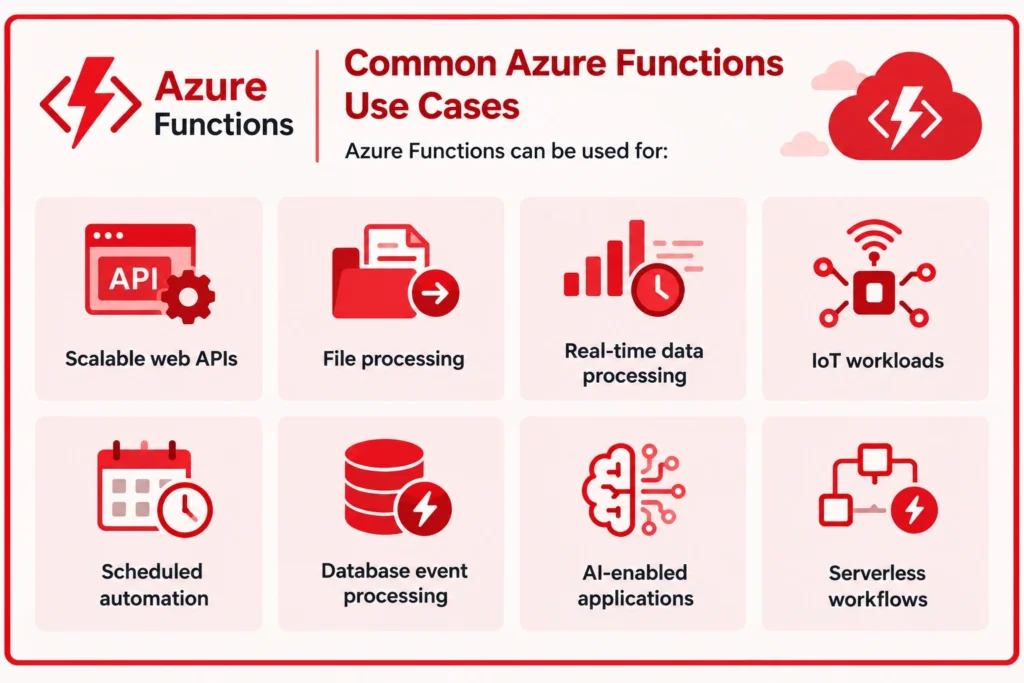
Microsoft specifically documents AI-enabled applications as an Azure Functions scenario, making Functions relevant to modern cloud-native and AI architectures.
Google Cloud Functions / Cloud Run Functions
Google Cloud has changed the terminology around its serverless functions platform.
Cloud Functions is now called Cloud Run functions. The current platform deploys functions as Cloud Run services, while the Cloud Functions v2 API remains available for compatibility.
Cloud Run functions allow developers to write single-purpose functions that respond to HTTP requests or cloud events without managing servers.
It integrates with Google Cloud services such as:
Cloud Storage
Pub/Sub
Eventarc
Firestore
Vertex AI
Cloud Run
Cloud Build
Artifact Registry
The current architecture also provides more flexibility than the original first-generation Cloud Functions model. For example, Cloud Run functions can support higher concurrency, configurable resources, and Cloud Run capabilities such as traffic splitting and Direct VPC configuration.
Common Cloud Run Functions Use Cases
Organizations can use Cloud Run functions for:
File processing
Event-driven applications
Streaming data processing
IoT workloads
AI and machine learning integrations
API backends
Automation
Firebase applications
AWS Lambda vs Azure Functions vs Google Cloud Functions
Feature | AWS Lambda | Azure Functions | Cloud Run functions |
Provider | AWS | Microsoft Azure | Google Cloud |
Serverless model | Function-based | Function-based | Function-based on Cloud Run |
Event-driven | Yes | Yes | Yes |
HTTP APIs | Yes | Yes | Yes |
Major ecosystem | AWS services | Azure services | Google Cloud services |
AI integration | AWS AI services | Azure AI services | Vertex AI and Google Cloud AI |
Containers | Supported | Supported through hosting options | Built into Cloud Run-based architecture |
Workflow options | Step Functions / Durable Functions | Durable Functions | Eventarc / Cloud Run ecosystem |
Monitoring | CloudWatch | Azure Monitor / Application Insights | Google Cloud observability |
Best fit | AWS-centric architectures | Microsoft/Azure-centric environments | Google Cloud/data/AI-centric environments |
The table describes broad architectural characteristics. Specific limits, runtimes, pricing, regions, and features can change, so organizations should verify current provider documentation before implementation.
Serverless and AI in 2026
Serverless is increasingly being used alongside AI applications.
For example, an application could follow this architecture:
User Request → API → Serverless Function → AI Service → Database → Response
A function might validate a request, retrieve data, call an AI model, process the result, and return the response.
Azure Functions, for example, includes documented scenarios for AI-enabled applications. Google Cloud also documents AI/ML use cases for Cloud Run functions.
This model can be useful for applications where AI processing needs to scale according to demand.
Serverless Cost Considerations
One of the major attractions of serverless is usage-based billing.
However, serverless does not automatically mean cheaper.
Costs can depend on:
Number of invocations
Execution duration
Memory or compute allocation
Network traffic
Storage
API calls
Database usage
Logging and monitoring
AI model usage
For applications with predictable, continuous workloads, other cloud compute models may sometimes be worth evaluating.
A good FinOps strategy should therefore consider the entire application architecture rather than looking only at the function’s execution cost.
Serverless Security Considerations
Serverless reduces infrastructure management but does not eliminate security responsibilities.
Organizations should implement:
Least-privilege identity and access
Secure secrets management
Input validation
Encryption
Network controls
Dependency management
Logging and monitoring
API authentication
Vulnerability management
The function itself may be small, but its permissions and connections to other cloud services can create significant security implications.
How to Choose Between AWS Lambda, Azure Functions and Google Cloud
The choice often starts with the cloud ecosystem already used by the organization.
Consider AWS Lambda When:
Your applications are primarily on AWS.
You rely heavily on AWS event and data services.
Your architecture uses services such as S3, DynamoDB, EventBridge, or API Gateway.
Consider Azure Functions When:
Your organization is invested in Microsoft Azure.
Applications use Azure services extensively.
You need integration with Microsoft identity, data, messaging, or AI services.
Consider Cloud Run Functions When:
Your workloads are built around Google Cloud.
Your architecture uses Pub/Sub, Eventarc, Cloud Storage, or Firebase.
You want functions deployed using the Cloud Run-based model.
Your applications have strong Google Cloud data or AI integration requirements.
Key Serverless Trends for 2026
Several trends are shaping serverless architecture.
AI integration: Functions can act as lightweight orchestration and integration layers for AI applications.
Event-driven architecture: Businesses are increasingly connecting applications through events rather than tightly coupled services.
Container-based serverless: Platforms are combining function simplicity with container-based deployment and configuration.
Workflow orchestration: Long-running and multi-step processes require more sophisticated orchestration capabilities.
FinOps: Teams are paying greater attention to execution costs, traffic, observability, and downstream service consumption.
Conclusion
AWS Lambda, Azure Functions, and Google Cloud’s Cloud Run functions all provide powerful approaches to serverless application development in 2026.
Your current cloud ecosystem, application design, programming needs, event sources, security model, AI integrations, and cost structure will all influence the best option.
AWS Lambda vs. Azure Functions vs. Google Cloud Functions is not the only architectural choice. Whether serverless is the best execution model for a given workload is the question.
Serverless can simplify infrastructure administration and speed up development for event-driven APIs, automation, data processing, integrations, and apps that require elastic scaling.
Serverless is getting more and more integrated with AI, containers, event-driven architectures, observability, and FinOps as cloud-native development advances, making it a crucial part of contemporary cloud strategy in 2026.
Want to Master Serverless Cloud Architecture for 2026?
Learn how to design and deploy scalable, event-driven, and cost-efficient serverless applications across Azure, AWS, and Google Cloud with guidance from a Microsoft Certified Trainer (MCT). Build practical skills in serverless architecture, cloud functions, APIs, event-driven applications, security, monitoring, and cloud-native development.
Recommended Microsoft Azure, Cloud & AI Certification Programs:
AZ-204: Developing Solutions for Microsoft Azure
AZ-305: Designing Microsoft Azure Infrastructure Solutions
AZ-104: Microsoft Azure Administrator
AZ-900: Microsoft Azure Fundamentals
Live Instructor-Led Training
Serverless & Cloud-Native Architecture Skills
Azure Functions, AWS Lambda & Google Cloud Functions
Event-Driven Application Development
APIs, Security & Cloud Integration
Real-World Serverless Cloud Projects
Certification Preparation & Career Guidance
– Email: trainings@debugdeploy.com
– WhatsApp: Contact us for quick assistance
Build your serverless cloud expertise and learn how to design scalable, secure, flexible, and cost-efficient applications using AWS, Azure, and Google Cloud in 2026.