

The complexity of today’s IT settings is rising. Cloud platforms, containers, APIs, apps, databases, networks, cybersecurity tools, and dispersed workloads across many environments are increasingly managed by organizations.
Businesses also want IT staff to maintain dependable digital services, minimize downtime, and identify issues promptly.
This is where AIOps are becoming more and more crucial.
Artificial Intelligence for IT Operations, or AIOps, helps IT teams monitor systems, spot anomalies, look into issues, and automate certain operational activities by utilizing artificial intelligence, machine learning, automation, analytics, and massive amounts of operational data.
By 2026, AIOps will have advanced from simple alert management and monitoring to more sophisticated and automated cloud and IT operations.
What Are AIOps?
AIOps is the use of AI and machine learning technologies to analyze IT operations data and improve monitoring, incident management, automation, and system performance.
Traditional IT monitoring often produces large numbers of alerts. IT engineers then need to investigate those alerts manually to determine whether they represent real problems.
AIOps can analyze information from multiple sources, including:
Application logs
Infrastructure metrics
Network telemetry
Cloud platforms
Security events
Databases
APIs
User activity
Application performance monitoring
Configuration data
AI and machine learning can then help identify unusual behavior, correlate related events, and prioritize operational issues.
Why AIOps Matters in 2026
The growth of cloud computing and AI is making IT environments more distributed.
Organizations may operate:
On-Premises + Private Cloud + Public Cloud + Containers + SaaS + AI Workloads
Operational complexity may result from monitoring each of these settings separately.
AIOps offers the chance to compile operational data and apply intelligent analysis to find trends that could be challenging to find by hand.
For instance, an AIOps platform might discover that multiple warnings are connected to the same underlying infrastructure or application event rather than hundreds of distinct alerts.
How AIOps Works
A typical AIOps workflow can be represented as:
Collect → Analyze → Correlate → Detect → Recommend → Automate → Learn
1. Collect
The platform gathers operational information from applications, infrastructure, networks, cloud environments, and other systems.
2. Analyze
AI and machine learning analyze the collected information to identify patterns and relationships.
3. Correlate
Related alerts and events can be grouped together to reduce operational noise.
4. Detect
The system identifies anomalies or behavior that differs from established patterns.
5. Recommend
The platform can provide possible explanations or recommended remediation actions.
6. Automate
For predefined scenarios, automation can perform selected remediation tasks.
7. Learn
Historical operational data can be used to improve detection and recommendations over time.
Key AIOps Capabilities
1. Intelligent Alert Management
One of the common problems in IT operations is alert overload.
AIOps can analyze alerts from multiple monitoring systems and identify relationships between them.
For example:
Database latency → API slowdown → Application errors → User complaints
Instead of treating these as four unrelated problems, intelligent event correlation can help teams investigate the underlying relationship.
2. Anomaly Detection
AIOps can establish patterns of normal system behavior and identify unusual changes.
Examples include:
Unexpected CPU utilization
Sudden memory consumption
Abnormal network traffic
Increased application latency
Unusual API activity
Unexpected error rates
This can help teams investigate potential problems earlier.
3. Predictive IT Operations
AIOps can analyze historical and real-time operational data to identify patterns associated with potential failures.
For example, a combination of increasing resource consumption, application latency, and error rates may indicate a developing infrastructure problem.
Predictive capabilities can support proactive investigation rather than relying entirely on reactive troubleshooting.
4. Automated Incident Response
AIOps can work with automation tools to perform predefined actions.
Examples include:
Restarting a failed service
Scaling resources
Clearing temporary files
Creating an incident ticket
Running diagnostic scripts
Redirecting traffic
Triggering predefined workflows
Organizations should apply appropriate safeguards, approvals, and access controls before allowing automated remediation to make production changes.
AIOps and Cloud Operations
Cloud environments generate large volumes of operational data.
AIOps can help teams analyze information across:
Virtual machines
Containers
Kubernetes
Serverless applications
Databases
Storage
Networks
APIs
Cloud services
This is particularly useful in multi-cloud and hybrid cloud environments where teams may need to monitor infrastructure across multiple platforms.
AIOps can therefore become part of a broader cloud operations strategy.
AIOps and DevOps
AIOps and DevOps solve different but complementary problems.
DevOps focuses on improving collaboration between development and operations while accelerating software delivery and reliability.
AIOps applies AI and automation to operational data and processes.
Together, they can support a continuous operational model:
Develop → Deploy → Monitor → Detect → Remediate → Improve
For example, operational insights generated after deployment can help development teams identify recurring performance or reliability issues.
AIOps and Generative AI
Generative AI is adding another dimension to AIOps.
Traditional machine learning can identify anomalies and patterns, while generative AI can help engineers interact with operational data using natural language.
An engineer might ask:
“Why did API latency increase after the latest deployment?”
An AI-powered operations platform could analyze relevant logs, metrics, deployment information, and traces and present potential contributing factors.
Generative AI can also assist with:
Incident summaries
Root-cause investigation
Runbook generation
Troubleshooting guidance
Documentation
Query generation
Post-incident reports
However, AI-generated recommendations should be validated against actual operational data before production actions are taken.
Benefits of AIOps
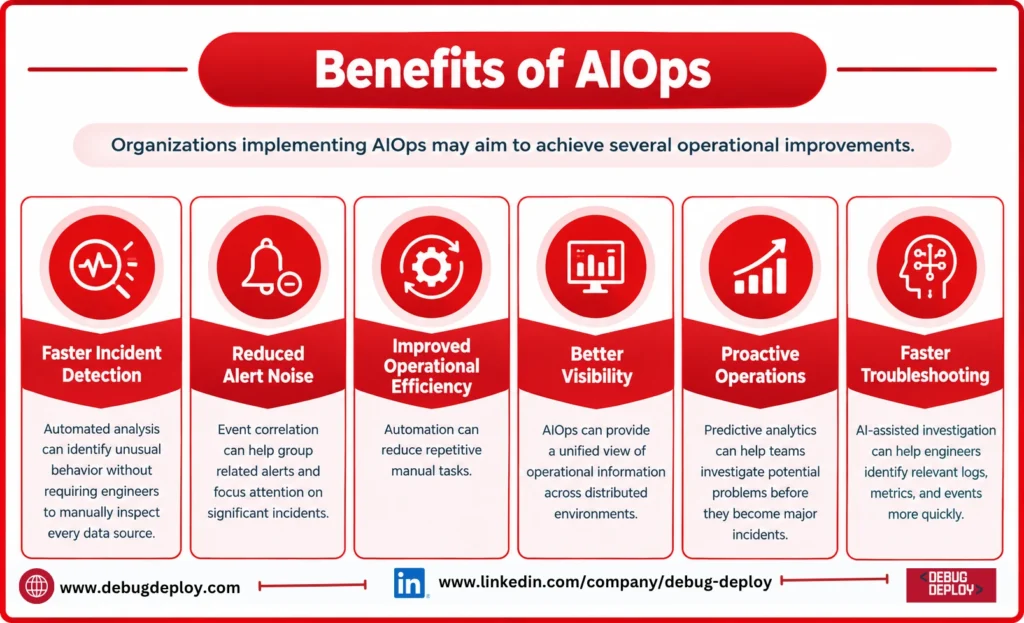
Organizations implementing AIOps may aim to achieve several operational improvements.
Faster Incident Detection
Automated analysis can identify unusual behavior without requiring engineers to manually inspect every data source.
Reduced Alert Noise
Event correlation can help group related alerts and focus attention on significant incidents.
Improved Operational Efficiency
Automation can reduce repetitive manual tasks.
Better Visibility
AIOps can provide a unified view of operational information across distributed environments.
Proactive Operations
Predictive analytics can help teams investigate potential problems before they become major incidents.
Faster Troubleshooting
AI-assisted investigation can help engineers identify relevant logs, metrics, and events more quickly.
AIOps Challenges
AIOps is not a replacement for good IT operations practices.
Organizations may encounter challenges such as:
Poor-quality operational data
Inconsistent monitoring
Excessive false positives
Complex integrations
Security and access concerns
Lack of AI expertise
Difficult-to-automate legacy systems
Trust in automated recommendations
The quality of an AIOps implementation depends heavily on the quality and context of the data it receives.
How to Implement AIOps in 2026
Organizations can take a phased approach.
Step 1: Identify Operational Pain Points
Start with issues such as alert fatigue, incident response, or cloud visibility.
Step 2: Consolidate Operational Data
Connect relevant logs, metrics, traces, events, and infrastructure information.
Step 3: Start With Observability
Ensure applications and infrastructure provide sufficient telemetry before applying advanced AI.
Step 4: Introduce AI-Assisted Analysis
Use anomaly detection, event correlation, and AI-assisted troubleshooting.
Step 5: Automate Low-Risk Tasks
Begin with well-defined actions such as ticket creation, diagnostics, or controlled resource management.
Step 6: Measure Results
Track metrics such as:
Mean time to detect (MTTD)
Mean time to resolve (MTTR)
Alert volume
Incident frequency
Automation rate
Service availability
The Future of AIOps
In 2026, AIOps is increasingly moving toward AI-assisted and partially autonomous IT operations.
The combination of:
Observability + Machine Learning + Generative AI + Automation + Cloud
can create more responsive operational environments.
Human oversight is still crucial, though, especially when it comes to significant changes in production, security, infrastructure, and compliance.
Removing IT engineers from the operational process is not the aim. Rather, AIOps can assist engineers in devoting more time to architecture, security, dependability, and strategic enhancements and less time to tedious research.
Conclusion
AIOps is becoming an important technology for managing increasingly complex IT and cloud environments in 2026.
Organizations can enhance their ability to identify incidents, investigate issues, and automate repetitive processes by integrating operational data, artificial intelligence, machine learning, observability, and automation.
AIOps can play a significant role in a contemporary IT operations strategy for companies implementing cloud, AI, hybrid infrastructure, and distributed applications.
Strong observability, trustworthy data, security controls, human oversight, and well-defined operational procedures will all be combined with intelligent automation in the most successful deployments.
Want to Master AIOps & AI-Driven IT Operations in 2026?
Learn how to use AI, automation, observability, and intelligent analytics to modernize IT operations with guidance from a Microsoft Certified Trainer (MCT). Build practical skills in AI-powered monitoring, incident detection, predictive analytics, automation, cloud operations, DevOps, and intelligent infrastructure management.
Recommended Microsoft Azure, AI & Cloud Certification Programs:
AI-102: Designing and Implementing a Microsoft Azure AI Solution
AZ-104: Microsoft Azure Administrator
AZ-305: Designing Microsoft Azure Infrastructure Solutions
AZ-900: Microsoft Azure Fundamentals
Live Instructor-Led Training
AIOps & AI-Driven IT Operations Skills
Intelligent Monitoring & Incident Detection
Predictive Analytics & Automated Remediation
Azure, Cloud & DevOps Integration
Real-World AI & Cloud Operations Projects
Certification Preparation & Career Guidance
– Email: trainings@debugdeploy.com
– WhatsApp: Contact us for quick assistance
Build your AIOps expertise and learn how AI and automation can help organizations improve IT visibility, detect issues faster, automate operational workflows, and manage modern cloud environments more efficiently in 2026.