
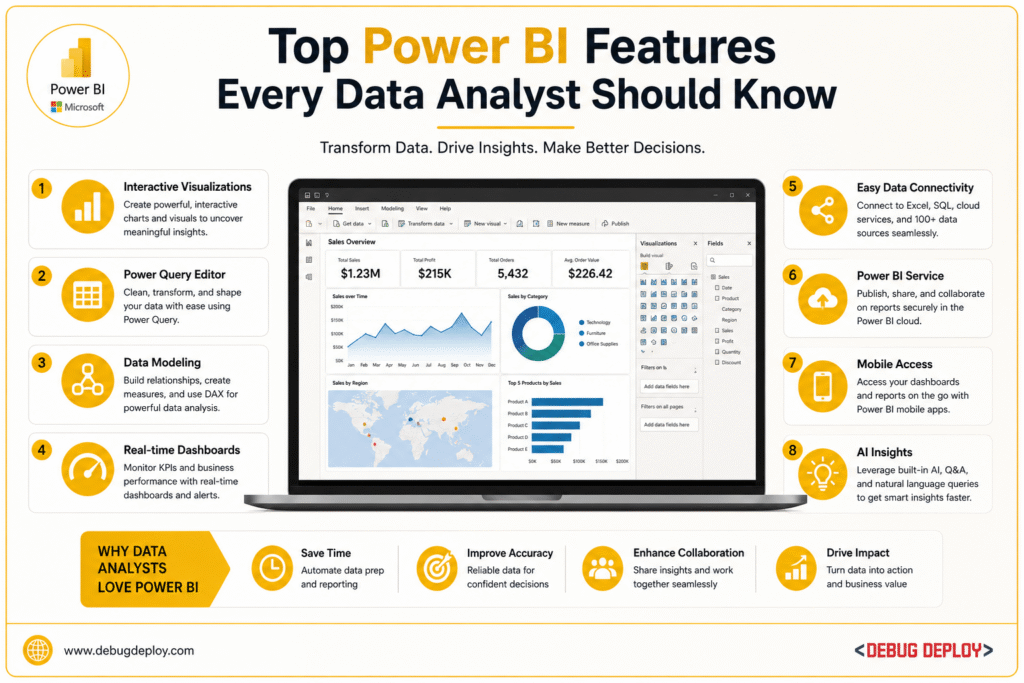
One of the most significant technologies for data analytics and business intelligence in 2026 is Power BI. Power BI is used by businesses in a variety of sectors to convert unstructured corporate data into insightful knowledge that facilitates quicker, more intelligent, and more strategic decision-making. Power BI assists companies in visualizing complicated data in an easy-to-use and interactive format for everything from financial analysis and sales reporting to operational dashboards and executive reporting.
Learning Power BI is becoming a must for contemporary data analysts. Businesses are expecting analysts to be knowledgeable in business intelligence workflows, dashboard development, data visualization, and reporting automation. Power BI’s extensive feature set that facilitates enterprise-scale reporting and streamlines data analysis is one of the key reasons it is still so widely used.
Understanding the core features of Power BI helps data analysts build better dashboards, improve reporting accuracy, automate workflows, and deliver more valuable business insights.
What Is Power BI?
Power BI is a business intelligence and data visualization platform developed by Microsoft. It allows users to connect multiple data sources, transform raw data, create interactive dashboards, and share reports across organizations.
Power BI supports:
Real-time analytics
Interactive visualizations
Cloud reporting
Data modeling
AI-powered insights
Business performance tracking
It is widely used by:
Data analysts
Business analysts
Finance teams
Marketing departments
Executives
IT professionals
Because of its flexibility and scalability, Power BI has become one of the leading BI tools globally.
Why Power BI Is Important for Data Analysts
Modern businesses generate enormous amounts of data from:
Websites
CRM systems
Financial platforms
ERP software
Cloud applications
Marketing campaigns
Customer interactions
Data analysts need tools capable of:
Connecting multiple data sources
Cleaning and transforming data
Visualizing trends
Automating reports
Supporting business decisions
Power BI provides all these capabilities within a single platform.
1. Data Connectivity
One of the strongest features of Power BI is its ability to connect with hundreds of data sources.
Supported sources include:
Excel files
SQL databases
SharePoint
Azure services
Google Analytics
Salesforce
APIs
Cloud platforms
This flexibility allows analysts to combine data from different systems into unified dashboards.
Strong data connectivity simplifies enterprise reporting significantly.
2. Interactive Dashboards
Power BI dashboards are highly interactive and user-friendly.
Users can:
Filter reports dynamically
Drill into detailed data
Explore trends visually
Interact with charts and KPIs
Interactive dashboards improve user engagement and make business analysis easier for decision-makers.
Unlike static spreadsheets, Power BI dashboards support real-time exploration of business data.
3. Power Query for Data Transformation
Raw data is often incomplete, inconsistent, or poorly structured.
Power Query Editor allows analysts to:
Remove duplicates
Clean missing values
Merge datasets
Split columns
Change data formats
Transform large datasets
This feature reduces dependency on external data-cleaning tools.
Data preparation is one of the most important stages of business intelligence workflows.
4. DAX (Data Analysis Expressions)
DAX is the formula language used in Power BI for creating custom calculations and business logic.
Analysts use DAX for:
Revenue calculations
Profit margins
Time intelligence
Year-over-year analysis
Running totals
KPIs
DAX enables advanced analytical reporting and dynamic calculations.
Learning DAX significantly improves analytical capabilities in Power BI.
5. Data Modeling
Power BI supports advanced data modeling features that allow analysts to create relationships between datasets.
For example:
Sales tables connected to customer data
Product tables connected to order history
Marketing data connected to campaign metrics
Data modeling improves reporting accuracy and supports scalable analytics solutions.
Strong data models are essential for enterprise-level dashboards.
6. Real-Time Analytics
Power BI supports real-time data streaming and live dashboard updates.
Organizations can monitor:
Sales performance
Website traffic
Financial transactions
Manufacturing operations
IoT devices
Customer support metrics
Real-time analytics helps businesses respond quickly to changing conditions and operational issues.
7. AI-Powered Insights
Power BI increasingly integrates artificial intelligence and machine learning capabilities.
AI features include:
Automated insights
Trend detection
Forecasting
Natural language queries
Smart narratives
Anomaly detection
These tools help analysts identify patterns faster and improve decision-making.
AI-driven analytics continues becoming more important in modern business intelligence.
8. Custom Visualizations
Power BI provides a wide range of built-in visualizations including:
Bar charts
Line graphs
Pie charts
Maps
KPI cards
Tables
Gauges
Additionally, analysts can import custom visuals from the Power BI marketplace.
Customized visualizations improve dashboard storytelling and reporting flexibility.
9. Drill-Through and Drill-Down Features
Power BI allows users to explore data at multiple levels.
For example:
Clicking a region to view city-level sales
Drilling into monthly revenue from yearly totals
Exploring product-level performance from category summaries
These features improve detailed business analysis without requiring multiple reports.
10. Cloud Publishing and Sharing
Power BI Service enables organizations to publish and share dashboards through the cloud.
Benefits include:
Team collaboration
Online dashboard access
Mobile reporting
Scheduled data refresh
Centralized reporting environments
Cloud-based reporting improves accessibility and operational efficiency.
11. Mobile Accessibility
Power BI dashboards can be accessed through smartphones and tablets.
Executives and teams can monitor business performance remotely using:
Mobile dashboards
Alerts
Interactive reports
Mobile accessibility supports faster decision-making across organizations.
12. Security and Access Control
Power BI includes enterprise-grade security features such as:
Row-level security
User permissions
Azure Active Directory integration
Data governance controls
Compliance support
Security is essential for protecting sensitive business information.
13. Integration With Microsoft Ecosystem
Power BI integrates naturally with Microsoft products such as:
Excel
Teams
Azure
SharePoint
Dynamics 365
SQL Server
This integration simplifies workflows for organizations already using Microsoft technologies.
14. Scheduled Data Refresh
Power BI can automatically refresh datasets at scheduled intervals.
This ensures dashboards always display updated information without manual intervention.
Automated refresh improves reporting efficiency and reduces operational workload.
15. Scalability for Enterprise Reporting
Power BI supports both small business reporting and large enterprise analytics environments.
Organizations can scale dashboards across:
Departments
Global offices
Large datasets
Complex business systems
This scalability makes Power BI suitable for organizations of all sizes.
Common Challenges Analysts Face in Power BI
While Power BI is powerful, beginners may encounter challenges such as:
Complex DAX formulas
Poor data modeling
Slow report performance
Data refresh failures
Inconsistent source data
Regular practice and hands-on projects help analysts overcome these issues over time.
Why Power BI Skills Matter in 2026
Businesses increasingly rely on analytics for:
Strategic planning
Customer analysis
Financial forecasting
Operational optimization
Marketing performance
Executive reporting
As data-driven decision-making continues growing, Power BI professionals remain highly valuable across industries.
Conclusion
One of the most crucial tools for contemporary data analysts is Power BI, which provides a potent combination of data connectivity, transformation, visualization, automation, AI integration, and corporate reporting capabilities. Analysts can develop scalable and intelligent business intelligence solutions with to features like DAX, Power Query, interactive dashboards, real-time analytics, and cloud sharing. Understanding Power BI’s fundamental features will continue to be crucial for data analysts hoping to establish successful careers in business intelligence and data analytics as companies continue to make significant investments in analytics and digital transformation in 2026.
Want to Master Power BI Like a Data Analyst?
Get trained by a Microsoft Certified Trainer (MCT) and learn the essential Power BI features used by data analysts to transform raw data into meaningful business insights.
Recommended Certification Program:
PL-300T00-A: Microsoft Power BI Data Analyst
✅ Live Instructor-Led Training
✅ Power Query & Data Transformation Skills
✅ DAX Functions & Formula Mastery
✅ Data Modeling & Relationship Management
✅ Interactive Dashboard & Visualization Techniques
✅ Real-World Reporting Scenarios
✅ Certification Exam Preparation & Guidance
📧 Email: trainings@debugdeploy.com
📱 WhatsApp: Contact us for quick assistance
Master the top Power BI features and build the analytics skills needed to become an in-demand data professional.