
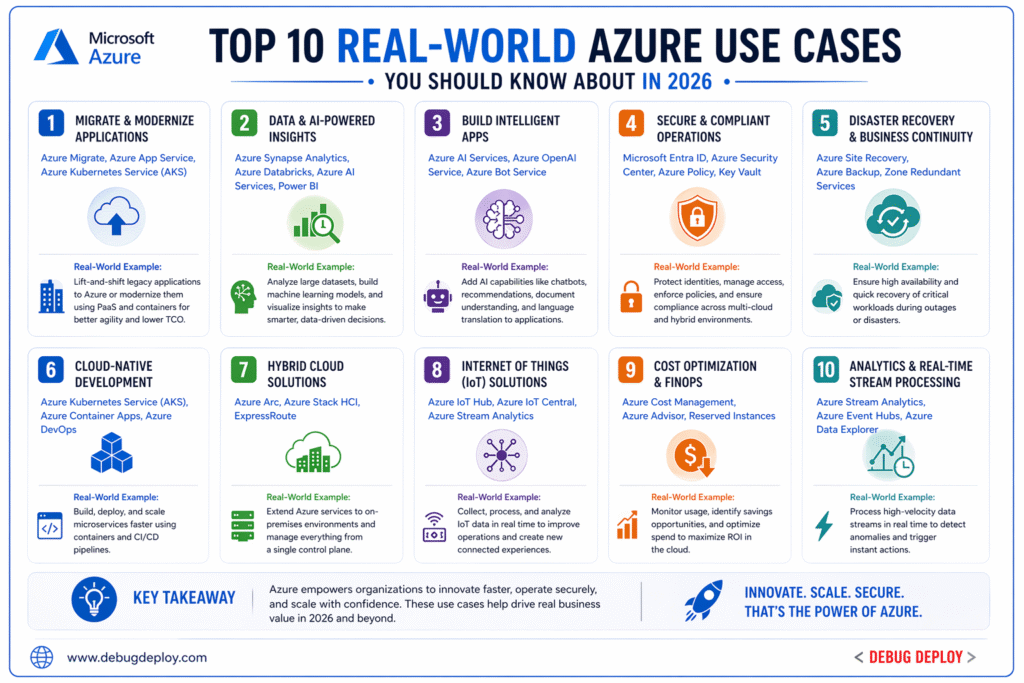
Cloud computing has become the backbone of modern business operations, enabling organizations to innovate faster, reduce infrastructure costs, and scale globally. In 2026, companies across industries rely heavily on cloud platforms to stay competitive, and Microsoft Azure stands out as one of the most widely adopted solutions. Azure offers a vast ecosystem of services that support everything from simple web hosting to advanced artificial intelligence and large-scale data processing. Understanding real-world Azure use cases helps beginners and professionals connect theory with practical applications and see how cloud technology is actually used in industries today.
1. Web Application Hosting
One of the most common and beginner-friendly use cases of Azure is web application hosting. Businesses use Azure App Services to deploy websites and applications without managing servers manually. Whether it’s a startup launching a new product or an enterprise managing customer portals, Azure allows developers to host applications quickly with built-in scalability, security, and monitoring. It supports multiple programming languages like .NET, Java, Python, and Node.js, making it flexible for different development needs. This use case is ideal for companies that want fast deployment and minimal infrastructure management.
2. Virtual Machines and Cloud Infrastructure
Azure provides virtual machines (VMs) that act like real servers but run in the cloud. Organizations use VMs to host applications, run legacy systems, and create testing environments. This eliminates the need for physical hardware and reduces maintenance costs. For example, a company migrating from traditional IT infrastructure can move its workloads to Azure VMs instead of investing in new servers. It also allows businesses to scale resources up or down based on demand, making it cost-efficient and flexible.
3. Data Storage and Backup Solutions
Data is one of the most valuable assets for any organization, and Azure provides multiple storage solutions to manage it efficiently. Azure Blob Storage is widely used for storing large amounts of unstructured data such as images, videos, and backups. Azure File Storage and Disk Storage support application data and virtual machines. In addition, Azure Backup and Recovery Services ensure data protection and disaster recovery. Companies use these services to safeguard critical information, maintain compliance, and ensure business continuity in case of data loss or system failure.
4. Disaster Recovery and Business Continuity
Unexpected events such as cyberattacks, hardware failures, or natural disasters can disrupt business operations. Azure Site Recovery helps organizations replicate workloads and data across regions, ensuring minimal downtime during failures. Businesses can quickly recover applications and maintain operations without significant losses. This is especially important for industries like finance, healthcare, and e-commerce, where downtime can lead to financial and reputational damage. Azure’s disaster recovery solutions provide reliability and peace of mind.
5. Big Data and Analytics
Modern organizations generate massive amounts of data daily, and Azure provides powerful tools to analyze it. Services like Azure Synapse Analytics and Azure Data Factory help businesses process large datasets and extract meaningful insights. Companies use these tools for customer analysis, sales forecasting, performance tracking, and decision-making. For example, a retail company can analyze customer purchase patterns to improve marketing strategies. Big data analytics on Azure helps businesses become more data-driven and competitive.
6. Artificial Intelligence and Machine Learning
Azure offers a wide range of AI and machine learning services that enable businesses to build intelligent applications. These include tools for natural language processing, image recognition, predictive analytics, and automation. Organizations use Azure AI for chatbots, recommendation engines, fraud detection systems, and personalized customer experiences. Even small businesses can leverage AI without building complex infrastructure from scratch. This use case is rapidly growing as companies look to automate processes and gain deeper insights from data.
7. DevOps and CI/CD Automation
Azure DevOps is widely used for automating software development workflows. It supports Continuous Integration (CI) and Continuous Deployment (CD), allowing developers to build, test, and deploy applications efficiently. Instead of manual deployment, code changes are automatically tested and pushed to production environments. This reduces errors, speeds up delivery, and improves collaboration between development and operations teams. Organizations adopting DevOps practices benefit from faster product releases and better software quality.
8. Internet of Things (IoT) Applications
Azure plays a major role in IoT solutions by connecting devices, sensors, and machines to the cloud. Industries like manufacturing, agriculture, logistics, and healthcare use IoT for real-time monitoring and automation. For example, a smart farming system can use sensors to monitor soil moisture and optimize irrigation. In manufacturing, IoT helps predict equipment failures and reduce downtime. Azure IoT services enable businesses to collect, analyze, and act on real-time data from connected devices.
9. Hybrid Cloud Environments
Not all organizations can move completely to the cloud immediately. Many still rely on on-premise systems due to regulatory, security, or operational reasons. Azure supports hybrid cloud environments, allowing businesses to integrate local infrastructure with cloud services. This means companies can run some applications on-premise while using Azure for scalability and backup. Hybrid cloud is especially useful for large enterprises transitioning gradually to the cloud while maintaining control over sensitive data.
10. Security and Identity Management
Security is a top priority for modern businesses, and Azure provides advanced tools to protect data and applications. Azure Active Directory helps manage user identities and control access to resources. Features like multi-factor authentication, role-based access control, and threat detection ensure secure operations. Organizations use Azure security services to protect against cyber threats, ensure compliance, and manage user access efficiently. Strong security capabilities make Azure suitable for industries with strict regulations such as finance and healthcare.
Frequently Asked Questions (FAQs)
What are the most common Azure use cases?
Cloud migration, web hosting, data analytics, AI/ML, and IoT are among the most common.
Is Azure suitable for small businesses?
Yes, Azure offers flexible pricing and scalable services suitable for businesses of all sizes.
Which industries use Azure the most?
Healthcare, finance, retail, and manufacturing widely use Azure.
Do I need coding skills to use Azure?
Basic knowledge helps, but many Azure services are low-code or no-code.
How can beginners start learning Azure?
Start with fundamentals (AZ-900), then move to hands-on projects and role-based certifications.
Related Reports
- How Power BI Drives Smarter Data-Driven Decisions
- Transitioning Your Data Workflow from Excel to Power BI
- What Is Microsoft Azure? 7 Powerful Reasons Beginners Should Care About Cloud Computing
- What Is Power BI? A Complete Beginner’s Guide (2026)
Conclusion
Microsoft Azure has evolved into a powerful cloud platform capable of supporting a wide range of real-world business needs—from cloud migration and web hosting to AI, IoT, and cybersecurity. Understanding these top Azure use cases gives you a clear picture of how organizations leverage cloud technology to drive efficiency, innovation, and scalability.
For learners and professionals, mastering these use cases is not just about theory—it’s about building practical, job-ready skills that align with industry demand. For businesses, choosing the right Azure use case can lead to cost savings, improved performance, and long-term growth.
As cloud adoption continues to accelerate in 2026 and beyond, those who understand how to apply Azure in real-world scenarios will have a strong competitive advantage. Whether you’re starting your cloud journey or advancing your career, Azure offers the tools and opportunities to succeed.
Want to Get Certified in Azure?
Get trained by a Microsoft Certified Trainer (MCT) and gain the practical cloud skills companies need in 2026.
Recommended Microsoft Azure training programs:
| Course Code | Course Title |
|---|---|
| AZ-900T00-A | Microsoft Azure Fundamentals |
| AZ-104T00-A | Microsoft Azure Administrator |
| AZ-305T00-A | Designing Microsoft Azure Infrastructure Solutions |
✅ Live Instructor-Led Training
✅ Hands-On Azure Labs
✅ Real-World Cloud Deployment Scenarios
✅ Security, Networking & Storage Concepts
✅ Certification Exam Guidance
📧 Email us: trainings@debugdeploy.com
📱 WhatsApp us for quick assistance
Start your Azure certification journey today and build a successful cloud career in 2026!