
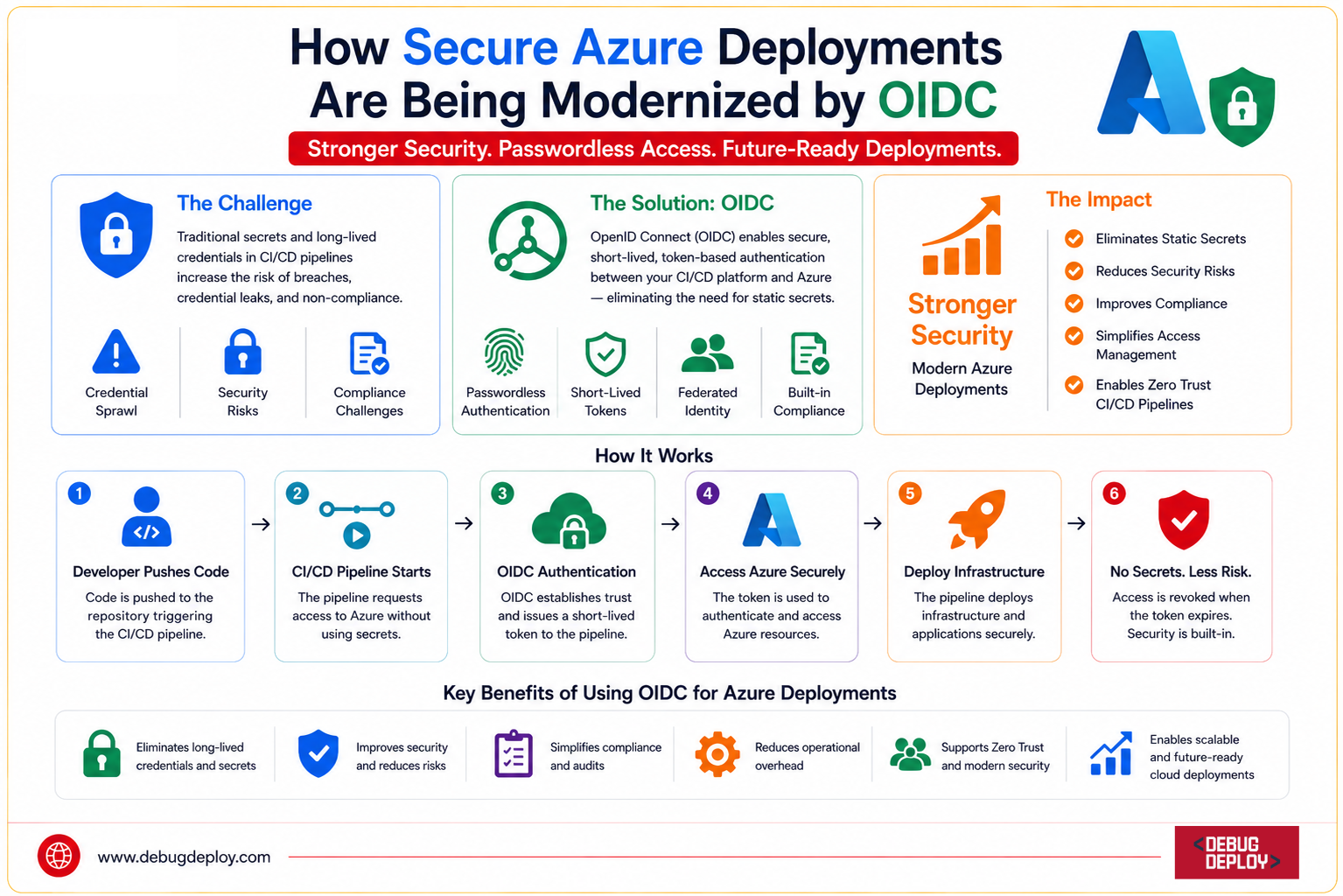
Security has emerged as one of the most crucial elements of application deployment as businesses quicken their cloud adoption process. In order to produce apps more quickly than before, modern development teams are adopting DevOps techniques, CI/CD pipelines, and Infrastructure as Code (IaC). However, the use of conventional authentication techniques in deployment pipelines frequently results in security vulnerabilities that might increase the attack surface and reveal crucial credentials.
Many enterprises are employing OpenID Connect (OIDC) to modernize Azure deployments in order to overcome these issues. By enabling safe, passwordless authentication between deployment platforms and Azure, OIDC greatly enhances cloud security by doing away with the need to keep long-lived secrets.
In this blog, we’ll explore what OIDC is, why traditional deployment authentication methods are becoming obsolete, and how OIDC is transforming secure Azure deployments.
Understanding OIDC
OpenID Connect (OIDC) is an identity layer built on top of the OAuth 2.0 protocol. It allows applications and services to securely verify identities and obtain access tokens without requiring stored credentials.
In simple terms, OIDC enables trusted systems to authenticate securely using short-lived tokens rather than static passwords, client secrets, or certificates.
Major DevOps platforms now support OIDC, including:
GitHub Actions
Azure DevOps
GitLab CI/CD
Terraform Cloud
Jenkins
Kubernetes environments
By integrating OIDC with Microsoft Azure, deployment workflows can securely access Azure resources without storing sensitive credentials.
The Security Problem with Traditional Azure Deployments
For years, Azure deployments relied on Service Principals authenticated through:
Client secrets
Certificates
Access keys
Stored credentials
While functional, these approaches introduce several security concerns.
Secret Management Challenges
Deployment pipelines often require secrets to be stored within:
CI/CD platforms
Environment variables
Secret vaults
Configuration files
Even when encrypted, these secrets remain attractive targets for attackers.
Credential Leakage Risks
Compromised credentials may occur due to:
Misconfigured repositories
Insider threats
Accidental exposure
Third-party breaches
A leaked secret can provide attackers with persistent access to Azure resources.
Secret Rotation Complexity
Security best practices require regular credential rotation.
However, rotating secrets across multiple repositories, environments, and pipelines can be time-consuming and error-prone.
Long-Lived Access
Traditional credentials often remain valid for extended periods.
If compromised, attackers may maintain access for weeks or months before detection.
These limitations have driven organizations toward more secure authentication mechanisms such as OIDC.
How OIDC Works with Azure
OIDC enables Azure to trust an external identity provider and issue temporary access tokens when deployment workflows are executed.
The process typically follows these steps:
A deployment workflow starts in a trusted CI/CD platform.
The platform generates a signed OIDC token.
Azure validates the token against a configured trust relationship.
Azure issues a short-lived access token.
The workflow uses the token to perform deployment tasks.
Access automatically expires after completion.
At no point are passwords, client secrets, or access keys stored within the deployment pipeline.
This creates a significantly more secure deployment model.
Benefits of OIDC for Azure Deployments
Passwordless Authentication
One of the biggest advantages of OIDC is the elimination of stored secrets.
Organizations no longer need to manage:
Service principal passwords
Client secrets
Deployment credentials
Long-lived certificates
This reduces both administrative overhead and security risks.
Improved Security Posture
OIDC follows the principle of least privilege.
Tokens are:
Short-lived
Scope-limited
Issued only when required
Automatically revoked after expiration
Even if a token were intercepted, its usefulness would be extremely limited.
Reduced Attack Surface
Without stored credentials, attackers have fewer opportunities to gain unauthorized access.
Organizations eliminate common attack vectors such as:
Secret theft
Credential reuse
Hardcoded passwords
Misconfigured secret storage
This substantially strengthens cloud security.
Simplified Compliance
Many security frameworks emphasize credential management and access control.
OIDC helps organizations align with requirements from:
ISO 27001
SOC 2
NIST
CIS Benchmarks
Zero Trust architectures
By reducing credential exposure, compliance efforts become easier to manage.
OIDC and Zero Trust Security
Modern security strategies increasingly follow a Zero Trust approach.
The core principle is simple:
Never trust, always verify.
OIDC aligns perfectly with this model because:
Every deployment request is validated.
Authentication is dynamic.
Access is temporary.
Identity is continuously verified.
Rather than granting broad, permanent permissions, Azure evaluates each request based on trusted identity assertions.
This significantly improves deployment security.
OIDC with GitHub Actions and Azure
One of the most common implementations involves GitHub Actions deploying resources to Azure.
Traditionally, developers stored Azure Service Principal credentials as GitHub secrets.
With OIDC:
GitHub generates a trusted identity token.
Azure validates GitHub’s identity.
Azure issues temporary deployment credentials.
No secrets are stored in repositories.
Benefits include:
Improved security
Simplified setup
Easier maintenance
Better auditability
Many organizations migrating to GitHub Actions now consider OIDC a standard security requirement.
OIDC for Infrastructure as Code
Infrastructure as Code (IaC) tools such as Terraform and Bicep play a major role in modern Azure deployments.
OIDC strengthens IaC security by providing temporary access during:
Resource provisioning
Environment updates
Policy deployments
Infrastructure changes
This eliminates the need to embed sensitive credentials within automation workflows.
As organizations scale their cloud environments, OIDC becomes increasingly valuable for maintaining secure and automated infrastructure management.
Enhancing DevSecOps Practices
DevSecOps aims to integrate security directly into software delivery processes.
OIDC supports this goal by:
Eliminating secret management challenges
Enforcing secure authentication
Supporting least-privilege access
Reducing operational risk
Security teams gain better visibility into deployment activities while developers enjoy a more streamlined experience.
This balance between security and productivity is a key reason for OIDC’s rapid adoption.
Operational Benefits Beyond Security
While security is the primary driver, OIDC also delivers operational advantages.
Reduced Administrative Overhead
Teams spend less time:
Managing secrets
Rotating credentials
Updating configurations
Troubleshooting authentication issues
Faster Deployment Pipelines
Authentication becomes more streamlined, reducing complexity within deployment workflows.
Better Scalability
As organizations expand cloud operations, OIDC scales efficiently across:
Multiple subscriptions
Multiple environments
Multi-cloud architectures
Large development teams
This supports long-term growth without increasing security risks.
Best Practices for Implementing OIDC in Azure
Organizations adopting OIDC should follow several best practices:
Use least-privilege role assignments.
Limit token permissions to required resources.
Separate environments using dedicated identities.
Monitor authentication logs regularly.
Enable conditional access policies where applicable.
Review trust relationships periodically.
Implement governance through Azure Policy.
Following these practices ensures maximum security and operational effectiveness.
Conclusion
Traditional credential-based deployment techniques are no longer enough as cloud environments grow more complicated and cyber threats keep changing. Authentication systems must be scalable, safe, and compliant with contemporary security standards.
By removing stored secrets, enabling passwordless authentication, and supporting Zero Trust security models, OpenID Connect (OIDC) is revolutionizing Azure installations. OIDC greatly lowers the risks related to credential management while streamlining deployment processes through identity-based access and short-lived tokens.
OIDC is quickly emerging as the preferred authentication standard for enterprises using cloud-native designs, DevOps, and Infrastructure as Code. Businesses can increase security, improve compliance, simplify operations, and safely extend their cloud infrastructure for the future by updating Azure deployments with OIDC.
Want to Build Secure Microsoft Azure Deployments?
Get trained by a Microsoft Certified Trainer (MCT) and learn how to modernize Azure deployments using OpenID Connect (OIDC), secure identity management, and DevSecOps best practices.
Recommended Microsoft Azure Certification Programs:
AZ-500: Microsoft Azure Security Technologies
AZ-400: Designing and Implementing Microsoft DevOps Solutions
AZ-104: Microsoft Azure Administrator Associate
AZ-900: Microsoft Azure Fundamentals
✅ Live Instructor-Led Training
✅ Azure Security & Identity Management
✅ OIDC Authentication & Workload Identity Federation
✅ DevSecOps & Secure CI/CD Pipelines
✅ Microsoft Entra ID & Access Control Best Practices
✅ Certification Exam Preparation & Guidance
📧 Email: trainings@debugdeploy.com
📱 WhatsApp: Contact us for quick assistance
Build secure Azure deployment skills by mastering OIDC, modern authentication, identity federation, and cloud security best practices for enterprise applications.