
Introduction
The adoption of cloud-native development and DevOps approaches by enterprises has made deployment pipeline security as crucial as application security. Developers use automation tools on a daily basis to manage cloud resources, update infrastructure, and launch apps. For many years, long-lived secrets, passwords, or service principal credentials were used to authenticate these automated processes to Azure.
These conventional techniques created security hazards even though they were effective. Secrets may be inadvertently revealed in source code, improperly preserved in repositories, or forgotten after workers depart a company. Another operational problem was managing credential rotation, which raised the possibility of illegal access in the event that credentials were compromised.
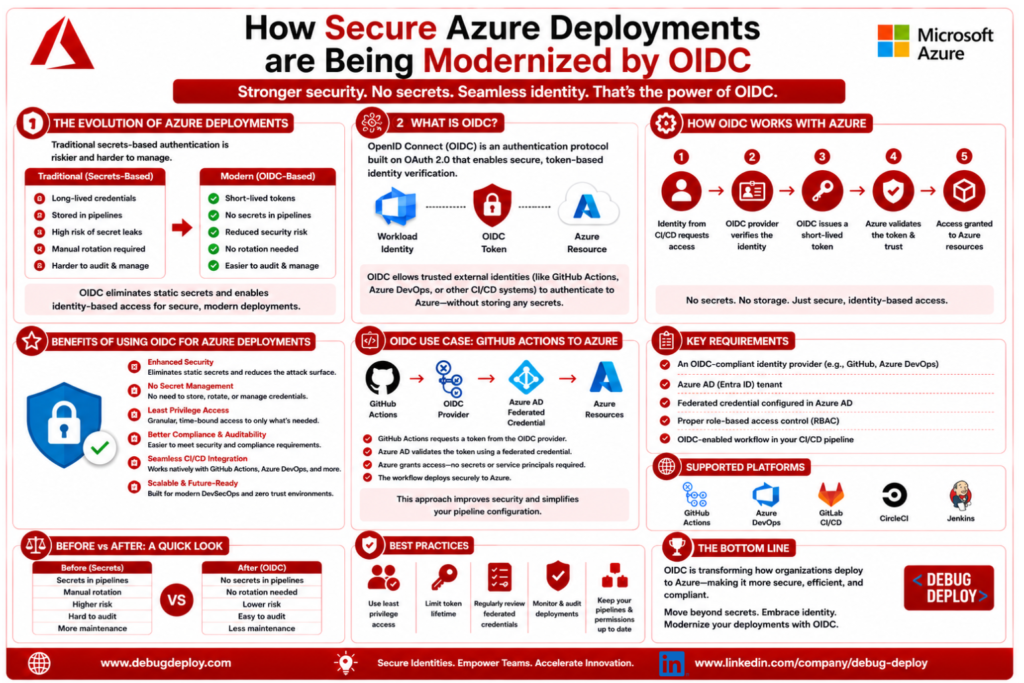
To address these challenges, Microsoft has embraced OpenID Connect (OIDC) as a modern authentication method for Azure deployments. OIDC enables trusted identity verification without requiring long-lived secrets, making deployment pipelines more secure, scalable, and easier to manage.
In this article, we’ll explore what OIDC is, why Azure is moving toward it, how it works, and why it’s becoming the preferred authentication method for modern cloud deployments.
What Is OpenID Connect (OIDC)?
The OAuth 2.0 authorization framework serves as the foundation for OpenID Connect, sometimes referred to as OIDC, an identification layer. It enables services and apps to securely and uniformly confirm the identification of users or automated processes.
OIDC employs transient identity tokens issued by a reliable identity provider, in contrast to conventional authentication techniques that rely on saved passwords or access keys. Without disclosing private information, these tokens demonstrate that the application or service making the request has been verified.
Before gaining access to Azure resources, deployment platforms like GitHub Actions or Azure DevOps can safely authenticate with Microsoft Entra ID thanks to OIDC.
Why Traditional Deployment Credentials Are a Security Risk
Azure deployment pipelines used service principals that were protected by client secrets or certificates for a long time. Despite being functional, this method raised a number of security issues.
The potential impact of credential theft increased since long-lived secrets frequently continued to function for months or even years. Developers occasionally kept confidential information in source code repositories, local computers, or configuration files, where it could unintentionally be discovered.
Administrators were still required to update deployment pipelines, rotate credentials on a regular basis, and keep an eye on secret expiration dates even in cases where firms employed secure secret management solutions. It soon became difficult and time-consuming to manage these credentials across several projects.
Attackers might be able to access cloud resources and deployment environments without authorization if a compromised secret went unnoticed.
How OIDC Changes Azure Authentication
OIDC substitutes short-lived identity tokens—which are created only during deployment—for static credentials.
The deployment platform initially authenticates with a reliable identity provider rather than keeping a permanent secret inside a deployment pipeline. A temporary token is issued following successful verification. Azure only allows access for the particular deployment request after verifying this token using Microsoft Entra ID.
The token cannot be utilized indefinitely due to its rapid expiration. Because of its short lifespan and limited rights, the token’s utility would be severely limited even if it were intercepted.
This method removes many of the hazards related to long-term credentials while drastically reducing the attack surface.
Understanding Workload Identity Federation
Workload Identity Federation is one of the main technologies underlying OIDC authentication in Azure.
Without the need for shared secrets, Workload Identity Federation builds confidence between Azure and external deployment platforms. Azure verifies signed identity tokens from reliable vendors like GitHub rather than sharing passwords or client secrets.
GitHub creates an OIDC token that identifies the workflow at the beginning of a deployment. That token is verified by Microsoft Entra ID using a defined trust relationship. Azure provides temporary credentials that let the deployment access only the resources it is authorized to use if everything is configured as expected.
No passwords, certificates, or manually managed secrets are involved in the process.
Benefits of Using OIDC for Azure Deployments
Enhanced Security
Eliminates the need to store long-lived credentials in deployment pipelines.
Reduces the risk of secrets being stolen, leaked, or accidentally exposed.
Simplified Credential Management
Removes the need to create, distribute, rotate, and manage client secrets.
Makes it easier to maintain multiple repositories and deployment environments.
Supports the Principle of Least Privilege
Issues temporary tokens with only the permissions required for a specific deployment.
Ensures tokens are valid only for a limited period, reducing security risks.
Improved Auditing and Compliance
Authentication events are centrally logged in Microsoft Entra ID.
Provides better visibility into deployment activities and access patterns for security teams.
More Secure and Manageable Deployments
Strengthens the overall security of cloud deployment pipelines.
Simplifies access control while improving governance and operational efficiency.
Azure Services That Benefit from OIDC
Many Azure services involved in the delivery of contemporary applications can employ OIDC authentication.
Deployments of Azure Kubernetes Service (AKS) can safely authenticate without adding credentials to automation scripts. Temporary identity tokens can be used to provision cloud resources in Infrastructure as Code deployments that use Terraform or Azure Bicep. OIDC can be used for secure authentication in Azure App Service, Azure Functions, Azure Container Apps, and Azure Resource Manager deployments.
In order to automate software releases while upholding strict security rules, organizations also leverage OIDC when combining Azure with GitHub Actions, Azure DevOps pipelines, and other CI/CD platforms.
OIDC is evolving into a common authentication method within the Azure ecosystem as cloud adoption increases.
A Simple Example
Consider a development team deploying a web application to Azure each time new code is added to the main branch using GitHub Actions.
In the past, GitHub was able to authenticate with Azure by storing a client secret in the workflow. It was necessary to keep the secret safe, rotate it frequently, and update it whenever it expired.
OIDC does not store any secrets. GitHub requests a temporary identity token at the start of the deployment. Microsoft Entra ID provides temporary access to Azure, validates the token, and attests to the workflow’s trustworthiness. The token automatically expires after the deployment is finished.
The deployment is still completely automated, but there are no longer any security risks related to permanent credentials.
Why OIDC Supports Zero Trust Security
The Zero Trust approach, which holds that no user, application, or workload should be automatically trusted, is becoming more and more prevalent in contemporary cybersecurity tactics.
By requiring each deployment request to individually authenticate using validated identity tokens, OIDC completely conforms with this idea. Azure constantly verifies identities before allowing access, as opposed to depending on credentials that are permanently trusted.
This method increases overall cloud security, decreases illegal access, and lowers the danger of credential theft.
OIDC is becoming a crucial part of secure cloud authentication as businesses continue to implement Zero Trust architectures.
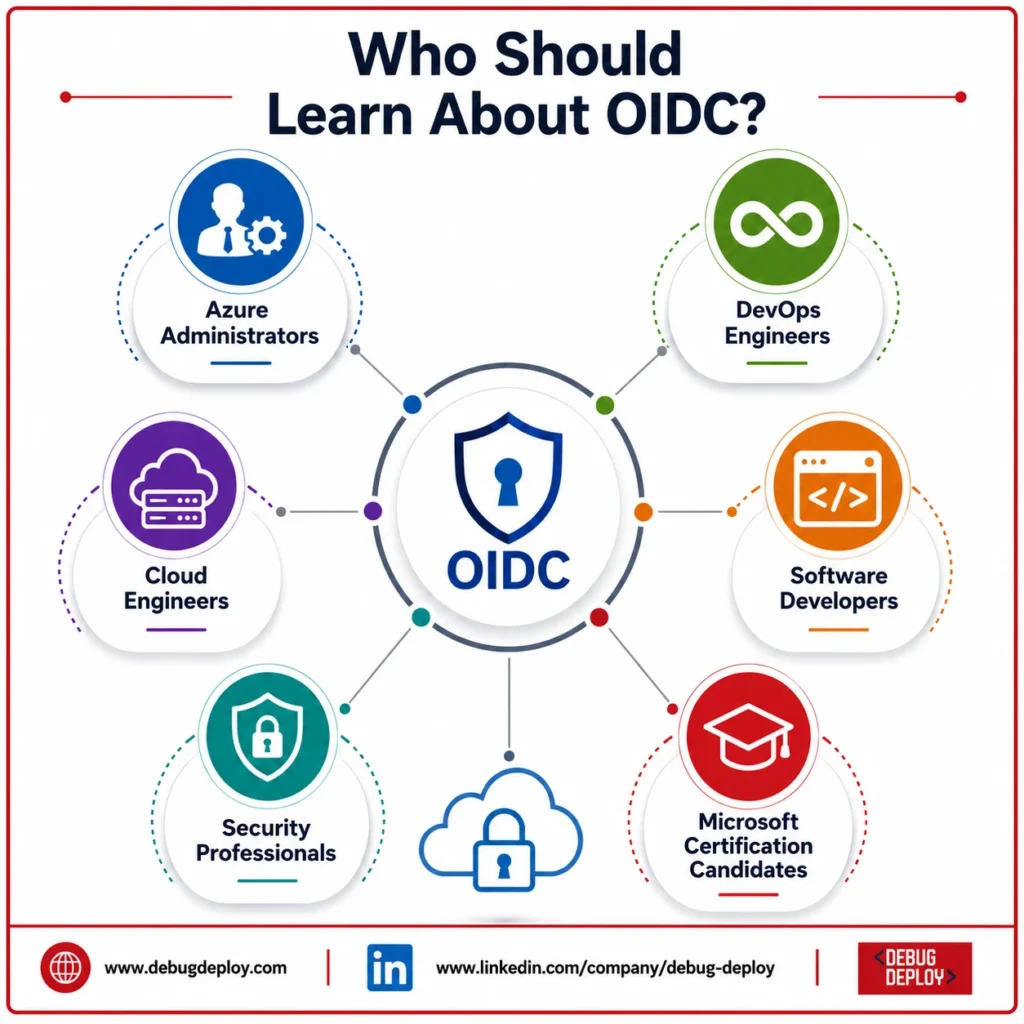
Who Should Learn About OIDC?
Azure Administrators
Use OIDC to improve the security of Azure deployments.
Eliminate the need for long-lived credentials in deployment workflows.
DevOps Engineers
Integrate OIDC into CI/CD pipelines for secure authentication.
Automate deployments without managing client secrets.
Software Developers
Build safer and more automated deployment processes.
Improve application security through identity-based authentication.
Cloud Engineers
Deploy infrastructure securely using temporary identity tokens.
Reduce the complexity of secret management.
Security Professionals
Implement identity-based authentication and access control policies.
Strengthen cloud security and governance practices.
Microsoft Certification Candidates
Essential for professionals preparing for:
AZ-104: Microsoft Azure Administrator
AZ-400: Designing and Implementing Microsoft DevOps Solutions
AZ-305: Designing Microsoft Azure Infrastructure Solutions
SC-300: Microsoft Identity and Access Administrator
Supports key certification topics such as identity management, cloud security, and governance.
Getting Started with OIDC in Azure
If you’re new to OIDC, start by learning the basics of Microsoft Entra ID, OAuth 2.0, authorization, and authentication. Examine how Workload Identity Federation fosters trust between Azure and external deployment platforms after these ideas are evident.
Next, set up OIDC authentication in place of a conventional service principal secret and establish a straightforward deployment pipeline using GitHub Actions or Azure DevOps. Try using Microsoft Entra ID to assign least-privilege rights and examine authentication logs.
Gaining practical experience will enable you to comprehend how contemporary identity-based authentication functions in actual cloud systems.
Conclusion
Organizations are adopting identity-based authentication in place of long-lived secrets as cloud security continues to advance. By enabling Azure installations to securely authenticate without retaining sensitive credentials, OpenID Connect (OIDC) is a major advancement.
Azure offers a more safe, scalable, and controllable method of deployment authentication with the use of temporary identity tokens, Workload Identity Federation, and Microsoft Entra ID. This improves security against unauthorized access and credential theft while simultaneously lowering operational complexity.
Knowing OIDC is becoming crucial for anyone working in cybersecurity, cloud administration, DevOps engineering, or development. OIDC will continue to be essential to creating dependable and safe cloud environments as more businesses update their Azure deployment processes.
Want to Get Certified in Azure Security & DevOps?
Get trained by a Microsoft Certified Trainer (MCT) and learn how to secure Azure deployments using modern authentication, OpenID Connect (OIDC), and DevOps best practices.
Recommended Microsoft Azure training programs:
| Course Code | Course Title |
|---|---|
| AZ-500T00-A | Microsoft Azure Security Technologies |
| AZ-400T00-A | Designing and Implementing Microsoft DevOps Solutions |
| AZ-104T00-A | Microsoft Azure Administrator |
✅ Live Instructor-Led Training
✅ Hands-On Azure Security & OIDC Labs
✅ Workload Identity & Secretless Authentication
✅ Secure CI/CD Pipeline Implementation
✅ Certification Exam Guidance
📧 Email us: trainings@debugdeploy.com
📱 WhatsApp us for quick assistance
Start your Azure Security certification journey today and master secure cloud deployments with modern identity solutions!