

Software development now proceeds more quickly than in the past. Quick software releases are made possible by cloud-native apps, APIs, containers, Kubernetes, artificial intelligence, and automated CI/CD pipelines. But quicker progress also brings with it new security risks.
Applications are frequently tested close to the end of the development lifecycle using traditional security techniques. Finding flaws at this point may result in further security concerns, costly remedies, and delayed releases.
By incorporating security into each phase of the software development and delivery process, DevSecOps tackles this problem. DevSecOps makes security a shared responsibility among development, security, and operations teams rather than a last checkpoint.
As businesses embrace cloud infrastructure, AI-powered apps, software supply-chain automation, and more complicated deployment settings in 2026, DevSecOps will become more crucial.
What Is DevSecOps?
DevSecOps is an approach that integrates security practices, tools, and controls into the DevOps lifecycle.
The traditional development process might look like:
Plan → Code → Build → Test → Deploy → Operate
DevSecOps adds security activities throughout these stages:
Plan → Secure Code → Build Securely → Security Testing → Secure Deployment → Continuous Monitoring
The goal is to identify and address security issues as early as possible rather than waiting until production.
DevSecOps does not mean that developers become security specialists. Instead, it encourages development, security, and operations teams to collaborate and use automated security controls throughout the software lifecycle.
Why DevSecOps Matters in 2026
Software environments have become more distributed and interconnected.
Organizations now commonly use:
Cloud platforms
Containers and Kubernetes
Infrastructure as Code
Microservices
APIs
Open-source dependencies
CI/CD pipelines
AI and machine learning services
Third-party SaaS platforms
Each component can introduce security considerations.
At the same time, development teams are expected to release software rapidly. Manual security reviews performed only before production deployment may not scale with this pace.
DevSecOps helps integrate security checks into automated workflows so teams can identify problems earlier.
DevSecOps Across the Software Lifecycle
A successful DevSecOps strategy includes security from planning through production operations.
1. Secure Planning
Security should begin before developers write code.
Teams can identify security requirements during the planning stage by asking:
What data will the application process?
Which regulatory requirements apply?
What authentication mechanisms are required?
Which users and services need access?
What security risks could affect the application?
Threat modeling can also help teams identify potential attack paths before implementation begins.
2. Secure Coding
Developers should follow secure coding practices while building applications.
Security tools can be integrated into development environments and source-control workflows to identify potential vulnerabilities.
Common activities include:
Static Application Security Testing (SAST)
Secret detection
Code quality analysis
Dependency analysis
Secure coding reviews
For example, a secret-scanning tool can identify accidentally committed API keys or credentials before they reach later stages of the pipeline.
3. Secure Dependencies
Open-source libraries and third-party packages are frequently used in modern applications.
Tools for Software Composition Analysis (SCA) can be used to find outdated components and weak dependencies.
Organizations should set up procedures for updating vulnerable packages and keep an eye on their software dependencies.
When applications have hundreds or thousands of third-party components, this becomes especially crucial.
4. Security in the CI Pipeline
The CI pipeline provides an important opportunity to automate security testing.
A pipeline can include checks such as:
Code → Build → SAST → SCA → Secret Scan → Container Scan → Tests
Every time developers make commits or pull requests, security checks can be performed automatically.
Teams can find numerous vulnerabilities using this method before an application is put into production.
Security controls, however, need to be set up carefully. Developers may become alert fatigued and disregard security findings if there are too many false positives.
5. Container and Kubernetes Security
Containers have become an important part of cloud-native application development.
DevSecOps practices can include scanning container images for known vulnerabilities before deployment.
For Kubernetes environments, organizations can also apply security controls around:
Kubernetes configurations
RBAC permissions
Network policies
Container privileges
Secrets
Admission controls
Image provenance
Runtime behavior
The goal is to ensure that security is considered both before deployment and while workloads are running.
6. Infrastructure as Code Security
Infrastructure as Code allows teams to define cloud infrastructure through configuration files.
Tools can scan Infrastructure as Code configurations for potentially insecure settings before they are deployed.
For example, automated checks can identify configurations involving:
Excessive permissions
Publicly exposed resources
Insecure network rules
Missing encryption
Weak authentication settings
This allows infrastructure security issues to be identified during development rather than after deployment.
7. Secure Deployment
Security should continue during the deployment stage.
Organizations can use automated policy controls to determine whether an application or infrastructure configuration meets defined security requirements before reaching production.
Deployment pipelines can also integrate:
Policy-as-Code
Approval workflows
Identity controls
Configuration validation
Image verification
Compliance checks
These controls help establish consistent security standards across environments.
8. Continuous Security Monitoring
DevSecOps does not end when an application reaches production.
Applications and infrastructure should be continuously monitored for suspicious activity, configuration changes, vulnerabilities, and operational anomalies.
Security monitoring can include:
Log analysis
Threat detection
Vulnerability management
Runtime monitoring
Identity monitoring
Cloud security monitoring
Security findings can be integrated with incident-management workflows so that teams can investigate and respond efficiently.
DevSecOps and AI in 2026
AI is becoming an increasingly important part of modern software development.
Developers may use AI coding assistants to generate code, documentation, tests, and configuration. Organizations are also deploying AI-powered applications that introduce new security considerations.
DevSecOps processes can help organizations apply security controls to AI-enabled development and applications.
Important areas include:
Protecting sensitive data
Validating AI-generated code
Managing model and API access
Securing AI dependencies
Monitoring AI application behavior
Protecting credentials and secrets
AI can also assist security teams by helping analyze large volumes of security findings and prioritize issues for investigation.
However, AI-generated code should still pass through established testing and security validation processes.
DevSecOps Tools and Technologies
A DevSecOps environment typically combines multiple categories of tools rather than relying on a single security platform.
Common categories include:
Security Area | Example Technology Category |
Source code | SAST |
Dependencies | SCA |
Secrets | Secret scanning |
Containers | Container security scanning |
Infrastructure | IaC security scanning |
Kubernetes | Cloud-native security tools |
Policies | Policy-as-Code |
Runtime | Runtime security |
Monitoring | SIEM and security monitoring |
The exact tools depend on the organization’s technology stack, cloud provider, compliance requirements, and development workflow.
Benefits of DevSecOps
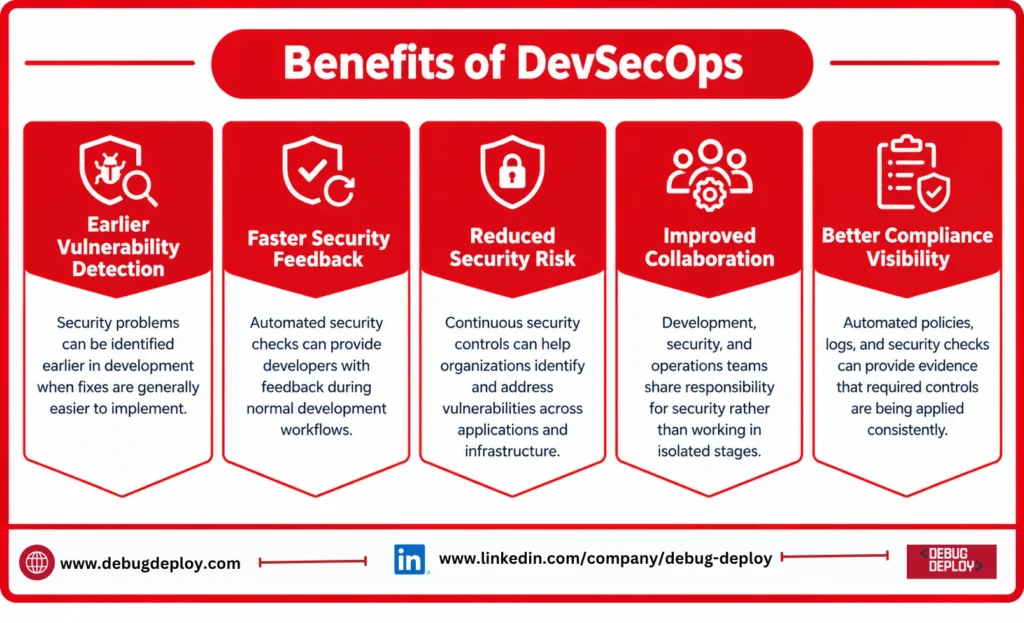
Implementing DevSecOps can provide several benefits.
Earlier Vulnerability Detection
Security problems can be identified earlier in development when fixes are generally easier to implement.
Faster Security Feedback
Automated security checks can provide developers with feedback during normal development workflows.
Reduced Security Risk
Continuous security controls can help organizations identify and address vulnerabilities across applications and infrastructure.
Improved Collaboration
Development, security, and operations teams share responsibility for security rather than working in isolated stages.
Better Compliance Visibility
Automated policies, logs, and security checks can provide evidence that required controls are being applied consistently.
Common DevSecOps Challenges
DevSecOps implementation can also create challenges.
Organizations may have difficulty integrating security into existing CI/CD pipelines without slowing development.
Too many security alerts can create noise and reduce developer engagement. Security teams therefore need to prioritize vulnerabilities based on risk and business context.
Legacy applications may also require additional effort because they were not designed with automated security testing in mind.
Successful DevSecOps requires more than installing security tools. It requires appropriate processes, automation, training, ownership, and collaboration.
DevSecOps Best Practices for 2026
Organizations building a DevSecOps strategy should consider the following practices:
Shift security left by introducing security checks early in development.
Automate repetitive security testing within CI/CD pipelines.
Protect secrets throughout source control and deployment environments.
Secure containers and Kubernetes before and after deployment.
Scan Infrastructure as Code before infrastructure changes are applied.
Use risk-based prioritization instead of treating every alert equally.
Monitor production continuously for vulnerabilities and suspicious activity.
Train developers in secure coding and security-aware development.
Secure the software supply chain by tracking dependencies and build artifacts.
Review DevSecOps policies regularly as applications and threats evolve.
Conclusion
DevSecOps in 2026 is about making security an integrated part of software development rather than a final stage before production.
By embedding security into planning, coding, dependency management, CI/CD, containers, Kubernetes, Infrastructure as Code, deployment, and monitoring, organizations can identify risks earlier and create more consistent security practices.
The most effective DevSecOps strategy combines automation, secure development practices, continuous monitoring, security-aware teams, and appropriate technology controls.
As cloud-native applications, AI, and software supply chains continue to evolve, integrating security throughout the delivery pipeline will remain an important part of modern software engineering.
Want to Master DevSecOps & Secure Cloud Development in 2026?
Learn how to integrate security into every stage of the software development and deployment lifecycle with guidance from a Microsoft Certified Trainer (MCT). Build practical skills in secure coding, CI/CD security, vulnerability management, cloud security, compliance, monitoring, and automated security testing.
Recommended Microsoft Azure, Security & DevOps Certification Programs:
AZ-204: Developing Solutions for Microsoft Azure
AZ-104: Microsoft Azure Administrator
AZ-305: Designing Microsoft Azure Infrastructure Solutions
AZ-900: Microsoft Azure Fundamentals
Live Instructor-Led Training
DevSecOps & Secure CI/CD Skills
Automated Security Testing & Vulnerability Management
Azure Cloud Security & Identity Integration
Secure Infrastructure, Containers & Kubernetes
Real-World DevSecOps Projects
Certification Preparation & Career Guidance
– Email: trainings@debugdeploy.com
– WhatsApp: Contact us for quick assistance
Build your DevSecOps expertise and learn how to integrate security into development, testing, deployment, and operations to create more secure and resilient cloud-native applications in 2026.