

Traditional storage solutions are no longer adequate to serve contemporary analytics, artificial intelligence (AI), machine learning (ML), and business intelligence (BI) workloads as enterprises continue to generate enormous volumes of organized and unstructured data. Today’s businesses need scalable, safe, and affordable systems that can store petabytes of data and provide real-time analysis and sophisticated insights. Data lakes are essential in this situation.
Amazon Web Services (AWS) and Microsoft Azure, two of the top cloud providers, provide robust data lake solutions that enable businesses centralize data from many sources, facilitate analytics, and promote data-driven decision-making. While Microsoft offers Azure Data Lake Storage Gen2 (ADLS Gen2), which is based on Azure Blob Storage with improved analytics capabilities, AWS largely bases its data lake architecture on Amazon Simple Storage Service (Amazon S3).
Although both platforms are extensively used in many different industries, their architecture, cost, security, integration, performance, scalability, and compatibility with ecosystems are different. To assist companies in selecting the best platform for their data management and analytics requirements, this guide offers a thorough comparison of AWS vs Azure Data Lake.
What Is a Data Lake?
Organizations can store organized, semi-structured, and unstructured data at any size using a data lake, which is a centralized storage repository. Data lakes store data in its original format until it is required for processing or analysis, in contrast to conventional databases or data warehouses.
Big data analytics, AI, machine learning, IoT data processing, business intelligence, log analytics, and real-time reporting are just a few of the workloads that data lakes support.
Organizations may perform advanced analytics, create predictive models, and obtain important business insights by combining data from several systems into a single platform without having to first change each dataset.
Overview of AWS Data Lake
Amazon S3 is usually used as the main storage layer for building an AWS Data Lake. To establish a comprehensive analytics platform, organizations integrate S3 with services like AWS Glue, Amazon Athena, Amazon Redshift, AWS Lake Formation, Amazon EMR, and Amazon SageMaker.
Amazon S3 offers incredibly robust and scalable object storage that can hold almost infinite volumes of data. By assisting businesses with the ingestion, cataloging, security, and governance of company data, AWS Lake Formation streamlines the process of creating data lakes.
AWS supports a broad ecosystem of analytics, machine learning, and data engineering services that integrate seamlessly with its storage platform.
Overview of Azure Data Lake
Azure Data Lake Storage Gen2 (ADLS Gen2) is a big data analytics-optimized enterprise-grade storage solution provided by Microsoft Azure. ADLS Gen2, which is based on Azure Blob Storage, offers faster analytics and better file management by combining scalable object storage with a hierarchical namespace.
Azure Synapse Analytics, Azure Databricks, Microsoft Fabric, Power BI, Azure Machine Learning, Azure Data Factory, and Microsoft Purview are all easily integrated with Azure Data Lake.
Azure’s extensive integration with the Microsoft cloud ecosystem makes it a popular choice for companies that already utilize Microsoft technology.
Key Features Comparison
Storage Architecture
The primary storage service used by AWS to create data lakes is Amazon S3. It supports several storage classes for cost optimization and provides extremely robust object storage with almost infinite scalability.
Azure Data Lake Storage Gen2 makes file operations like renaming, relocating, and directory management quicker and more effective for analytics applications by combining object storage with a hierarchical namespace.
Scalability
Nearly infinite storage capacity is provided by both AWS and Azure. Businesses don’t have to worry about infrastructure constraints while scaling storage capacity.
While Azure ADLS Gen2 offers elastic scalability for enterprise data lakes and analytics applications, AWS automatically scales S3 buckets to handle expanding datasets.
Data Processing Integration
AWS integrates with services including:
AWS Glue
Amazon Athena
Amazon EMR
Amazon Redshift
AWS Lake Formation
Amazon SageMaker
Azure integrates with:
Azure Synapse Analytics
Azure Databricks
Azure Data Factory
Microsoft Fabric
Azure Machine Learning
Power BI
Both ecosystems provide comprehensive analytics capabilities, although Azure offers stronger integration with Microsoft’s business intelligence tools.
Performance Comparison
Instead of relying solely on storage, performance is influenced by networking, analytics services, workload planning, and storage architecture.
For large-scale object storage and high-volume data processing, AWS S3 offers outstanding throughput. It works well for large-scale analytics, machine learning, and distributed computing.
Azure Data Lake Storage Gen2’s hierarchical namespace enhances metadata operations and file management efficiency, resulting in improved performance for analytics workloads. Azure is especially useful for Hadoop and Spark-based analytics because of this.
For demanding workloads, both platforms offer enterprise-grade performance.
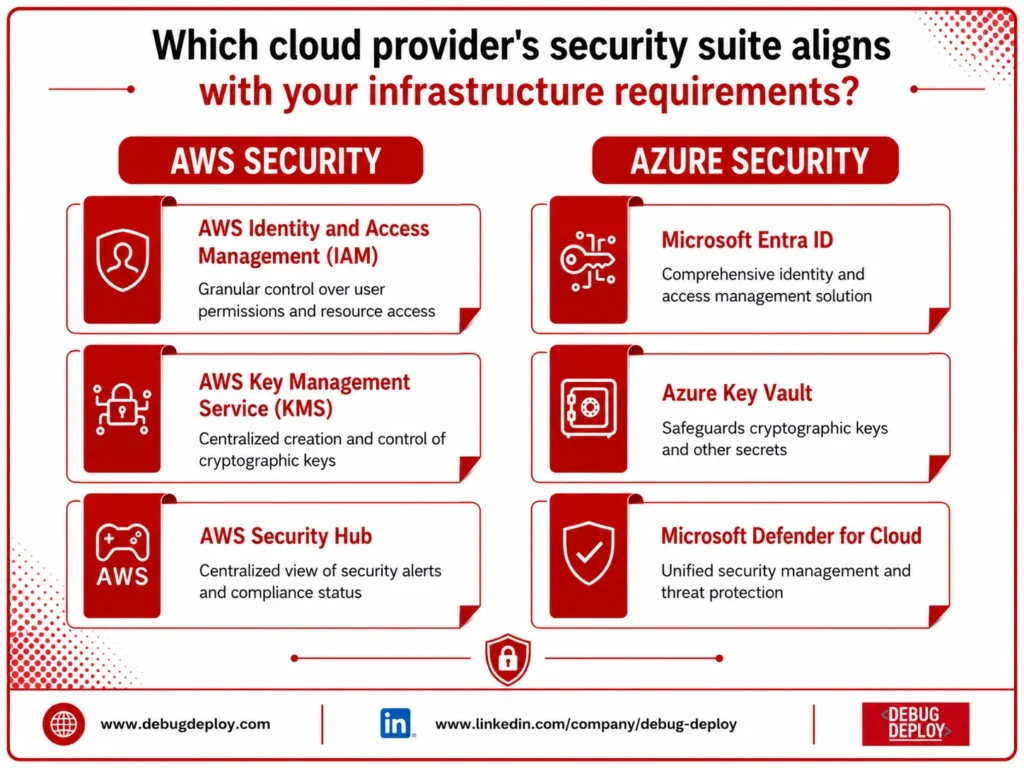
Security Comparison
Security is a critical requirement for enterprise data lakes.
AWS Security Features
AWS provides:
AWS Identity and Access Management (IAM)
AWS Key Management Service (KMS)
AWS Lake Formation security controls
Amazon Macie
AWS CloudTrail
AWS Security Hub
Encryption at rest and in transit
Azure Security Features
Azure provides:
Microsoft Entra ID
Azure Role-Based Access Control (RBAC)
Azure Key Vault
Microsoft Defender for Cloud
Azure Policy
Microsoft Purview
Encryption at rest and in transit
Both cloud providers offer enterprise-grade security and compliance capabilities suitable for regulated industries.
Pricing Comparison
AWS and Azure both follow pay-as-you-go pricing models.
AWS Pricing
AWS charges based on:
Storage consumed
Data retrieval
API requests
Data transfer
Analytics service usage
Amazon S3 offers multiple storage classes, including Standard, Intelligent-Tiering, Glacier Instant Retrieval, Glacier Flexible Retrieval, and Glacier Deep Archive for long-term cost savings.
Azure Pricing
Azure Data Lake pricing depends on:
Storage capacity
Transactions
Data transfer
Redundancy options
Analytics services used
Azure provides Hot, Cool, and Archive storage tiers that help optimize costs based on data access frequency.
Actual costs vary depending on workload size, access patterns, and supporting cloud services.
Data Governance
Effective governance ensures data quality, security, and compliance.
AWS provides governance using:
AWS Lake Formation
AWS Glue Data Catalog
AWS IAM
AWS CloudTrail
Azure supports governance with:
Microsoft Purview
Azure Policy
Microsoft Entra ID
Azure Monitor
Organizations with strict compliance requirements often benefit from Azure’s integration with Microsoft governance solutions.
Integration with Analytics and AI
AWS Ecosystem
AWS integrates with:
Amazon SageMaker
Amazon Athena
Amazon Redshift
Amazon EMR
AWS Glue
QuickSight
Azure Ecosystem
Azure integrates with:
Azure Synapse Analytics
Microsoft Fabric
Azure Databricks
Azure Machine Learning
Power BI
Azure AI services
Organizations already invested in Microsoft analytics often find Azure easier to integrate with existing business tools.
Disaster Recovery and Availability
Both platforms provide highly resilient storage.
AWS offers:
Cross-region replication
Multi-region storage
Versioning
Lifecycle policies
Azure provides:
Geo-redundant storage
Zone-redundant storage
Read-access geo-redundant storage
Automated backup capabilities
Both ensure high durability and business continuity.
Which Platform Is Better for Microsoft Environments?
Organizations using:
Microsoft 365
Power BI
Azure AI
Azure Synapse Analytics
Microsoft Fabric
SQL Server
generally experience smoother integration with Azure Data Lake.
Azure’s unified ecosystem simplifies identity management, reporting, and enterprise analytics.
Which Platform Is Better for Multi-Cloud Environments?
Organizations already using AWS services, Kubernetes, or multi-cloud architectures may benefit from AWS Data Lake because of its broad cloud ecosystem and flexible service integrations.
AWS also provides extensive third-party support across diverse technology stacks.
When Should You Choose AWS Data Lake?
AWS is often the better choice if your organization:
Already uses AWS infrastructure.
Requires highly customizable cloud architectures.
Runs large-scale machine learning workloads.
Operates in a multi-cloud environment.
Needs extensive third-party integrations.
When Should You Choose Azure Data Lake?
Azure is typically the better choice if your organization:
Uses Microsoft 365 extensively.
Relies on Power BI for analytics.
Uses Azure Synapse Analytics or Microsoft Fabric.
Wants seamless Microsoft ecosystem integration.
Requires enterprise identity management with Microsoft Entra ID.
Best Practices for Data Lake Implementation
Regardless of the cloud platform, organizations should:
Define a clear data governance strategy.
Organize data using consistent folder structures.
Enable encryption for all sensitive data.
Implement role-based access controls.
Monitor storage costs regularly.
Archive infrequently accessed data.
Automate data ingestion and lifecycle management.
Continuously monitor performance and security.
Following these practices improves scalability, compliance, and operational efficiency.
Future of Cloud Data Lakes
Cloud data lakes will increasingly include AI-powered data management, automated governance, intelligent query optimization, real-time analytics, and closer interaction with machine learning platforms as data volumes continue to rise. AWS and Microsoft Azure are both making significant investments in these features, which allow businesses to reduce operational complexity and extract more value from their data.
Conclusion
Both AWS Data Lake and Azure Data Lake Storage Gen2 are robust enterprise-level systems that can handle workloads related to business intelligence, AI, machine learning, and contemporary analytics. For businesses that have already invested in Amazon Web Services, AWS is a great option because of its great flexibility, extensive ecosystem of analytics services, and robust support for multi-cloud settings. Azure Data Lake, on the other hand, is especially appealing to Microsoft-centric businesses since it offers smooth connectivity with Microsoft’s cloud ecosystem, which includes Power BI, Azure Synapse Analytics, Microsoft Fabric, and Microsoft Entra ID. Your current technology stack, business goals, budget, security needs, and long-term cloud strategy will ultimately determine which option is best for you. By carefully evaluating these factors, businesses can select the data lake platform that best supports their analytics initiatives and future digital transformation goals.
Want to Build Expertise in Cloud Data Lakes with Microsoft Azure?
Learn how to design, manage, and optimize modern Azure data lake and cloud data platforms with guidance from a Microsoft Certified Trainer (MCT). Develop practical skills to support data engineering, analytics, cloud migration, and AI-ready data strategies.
Recommended Microsoft Azure & Data Certification Programs:
AZ-900: Microsoft Azure Fundamentals
DP-900: Microsoft Azure Data Fundamentals
DP-203: Data Engineering on Microsoft Azure
DP-300: Administering Microsoft Azure SQL Solutions
✅ Live Instructor-Led Training
✅ Azure Data Lake & Cloud Data Platform Skills
✅ Data Engineering & Analytics Concepts
✅ Data Storage, Security & Governance Best Practices
✅ Azure Data & AI Architecture Concepts
✅ Certification Exam Preparation & Career Guidance
📧 Email: trainings@debugdeploy.com
📱 WhatsApp: Contact us for quick assistance
Build modern cloud data skills with Microsoft Azure and prepare to design scalable, secure, and AI-ready data platforms for next-generation business solutions.