
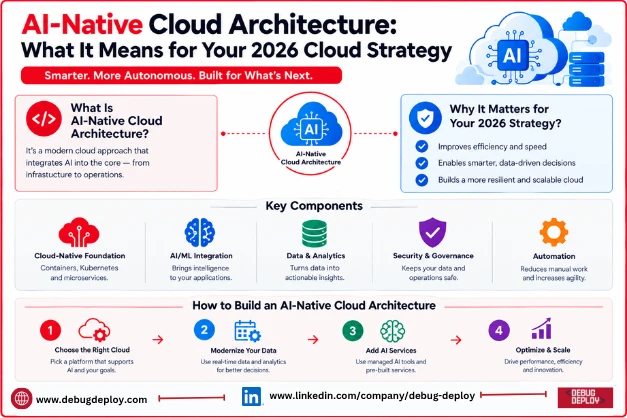
Cloud environment design, deployment, and management are all being altered by artificial intelligence. By 2026, businesses will be doing more than just integrating AI tools into their current cloud infrastructure. In order to facilitate AI workloads, intelligent automation, real-time data processing, and scalable machine learning applications, they are implementing an AI-native cloud architecture that was created from the bottom up.
Understanding AI-native architecture is becoming more and more crucial for companies designing their cloud strategy for 2026. It can assist companies in creating cloud environments that are better suited to AI-driven applications while enhancing the interoperability of data, computation, security, and apps.
What Is AI-Native Cloud Architecture?
Instead than treating AI as an add-on, AI-native cloud architecture is a cloud architecture strategy created especially to accommodate AI and machine learning as core capabilities.
Applications, databases, virtual machines, and storage may have been the main architectural elements of traditional cloud setups. AI-native settings prioritize:
AI and machine learning workloads
Data availability and quality
GPU and specialized compute
Real-time data pipelines
AI APIs and foundation models
MLOps and model lifecycle management
Automated infrastructure
Security and governance for AI workloads
The goal is to create an environment where AI applications can consume data, access computing resources, deploy models, and scale efficiently.
Why AI-Native Architecture Matters for Your 2026 Cloud Strategy
Customer service, software development, analytics, cybersecurity, marketing, operations, and business intelligence are all seeing an increase in the use of AI. Infrastructure must develop in tandem with AI applications as they become increasingly integrated into corporate operations.
Moving apps from on-premises infrastructure to cloud platforms might be the main goal of a traditional cloud migration plan. An AI-native approach goes one step further and inquires:
Is our cloud environment ready to support AI at scale?
This shift can influence decisions around cloud computing, data architecture, application development, security, and cost management.
1. AI Becomes Part of the Core Architecture
Organizations can incorporate AI capabilities into their larger cloud architecture rather than building a distinct AI environment.
For instance, a shared cloud ecosystem may link a business application to analytics services, enterprise data platforms, APIs, and AI services.
This method can facilitate the development of applications like:
AI-powered customer support
Intelligent document processing
Predictive analytics
Recommendation systems
Generative AI assistants
Automated business workflows
AI-enhanced cybersecurity solutions
2. Data Becomes the Foundation of AI-Native Cloud
Accessible, trustworthy, and controlled data is essential to AI applications.
Organizations must therefore reconsider their cloud data strategy in light of an AI-native cloud architecture. Depending on the needs of the organization, data lakes, data warehouses, lakehouses, databases, streaming platforms, and analytics services may all be important.
Key competencies consist of:
Centralized data governance
Data quality management
Real-time data processing
Secure data access
Metadata and data discovery
Data integration
Observability and monitoring

Poor-quality or inaccessible data can limit the effectiveness of even the most advanced AI models.
3. Infrastructure Must Support AI Workloads
Infrastructure requirements for AI workloads can differ greatly from those of traditional business applications.
GPUs and other AI accelerators are examples of specialized compute resources that may be needed for training and executing AI models. Therefore, when creating their cloud strategy for 2026, organizations must take infrastructure flexibility into account.
Scalable computing resources can be accessed through cloud platforms without requiring businesses to own and maintain all specialized hardware.
A contemporary building could incorporate:
Applications → APIs → AI Services → Data Platform → Specialized Compute → Monitoring & Governance
This creates an integrated environment for developing and operating AI solutions.
4. Generative AI Changes Application Architecture
Generative AI introduces new architectural patterns.
Applications may now connect with large language models, retrieval systems, vector databases, enterprise data sources, and AI orchestration frameworks.
A typical enterprise generative AI architecture may include:
User → Application → AI Orchestration → Retrieval Layer → Enterprise Data → AI Model → Response
Retrieval-augmented generation (RAG), vector search, prompt management, model monitoring, and access controls can become important components.
Organizations should therefore consider AI application architecture alongside traditional application architecture when planning cloud modernization.
5. Security and Governance Must Evolve
AI-native cloud architecture introduces additional security and governance considerations.
Organizations need to determine:
Who can access AI models?
What enterprise data can AI applications access?
How is sensitive information protected?
How are AI interactions monitored?
How are models evaluated?
How are third-party AI services governed?
How are regulatory requirements addressed?
Identity and access management, encryption, network security, data governance, logging, and monitoring remain important. AI-specific controls should complement—not replace—existing cloud security practices.
6. Cloud FinOps Becomes More Important
AI workloads can create significant and variable infrastructure costs.
A cloud strategy for 2026 should therefore include FinOps and AI cost management from the beginning.
Organizations can monitor:
GPU utilization
Model inference costs
Storage consumption
Data processing costs
API usage
Application-level AI expenses
Resource utilization
Cost optimization should be considered during architecture design rather than after an AI application reaches production.
AI-Native vs Traditional Cloud Architecture
Area | Traditional Cloud Architecture | AI-Native Cloud Architecture |
Primary focus | Applications and infrastructure | AI-enabled applications and intelligence |
Data | Application data | AI-ready, governed data |
Compute | CPU-focused workloads | CPU, GPU, and specialized AI compute |
Applications | APIs and microservices | APIs, AI services, agents, and orchestration |
Analytics | Reporting and dashboards | Predictive and AI-driven analytics |
Operations | Infrastructure monitoring | Infrastructure, model, data, and AI monitoring |
Security | Application and infrastructure security | Security plus AI/data governance |
Cost management | Cloud resource costs | Cloud + AI/model workload costs |
How to Build an AI-Native Cloud Strategy in 2026
Organizations do not necessarily need to rebuild their entire cloud environment. A phased approach can reduce complexity.
Step 1: Assess Your Existing Cloud Environment
Review your applications, infrastructure, data platforms, security controls, and current AI workloads.
Identify systems that could benefit from AI and determine whether the existing architecture can support them.
Step 2: Modernize the Data Foundation
Create reliable pipelines and governed data platforms that AI applications can access securely.
Step 3: Identify High-Value AI Use Cases
Start with business problems where AI can provide measurable value, such as automation, customer support, forecasting, knowledge management, or analytics.
Step 4: Design for Scalability
Choose cloud services and architecture patterns that can scale as AI adoption increases.
Step 5: Build Security and Governance Into the Architecture
Establish identity, access controls, data governance, monitoring, compliance, and responsible AI practices before production deployment.
Step 6: Continuously Monitor Performance and Cost
AI-native architecture is not a one-time implementation. Monitor application performance, model quality, infrastructure utilization, security, and costs continuously.
What Does AI-Native Cloud Architecture Mean for Businesses?
The biggest change is strategic.
Cloud is no longer only an infrastructure destination. It is increasingly becoming the foundation for data, AI, automation, analytics, and intelligent applications.
Organizations planning their 2026 cloud strategy should therefore evaluate cloud architecture through an AI-ready lens. The right architecture can help teams connect applications, data, AI services, security, and infrastructure into a scalable technology ecosystem.
Conclusion
The transition from merely executing AI workloads in the cloud to creating cloud environments around AI-driven business requirements is known as AI-native cloud architecture.
Businesses should think about integrating AI, data, specialized compute, security, governance, scalability, and FinOps into their cloud strategy in 2026.
An AI-native strategy can offer a framework for creating cloud environments that are ready for the next phase of digital transformation, regardless of whether a company is updating current apps, creating generative AI solutions, or creating new intelligent goods.
Do you want to update your cloud infrastructure for artificial intelligence? Examine how data platforms, cloud architecture, and AI services can support your company’s 2026 IT strategy.
Want to Master AI-Native Cloud Architecture for Your 2026 Cloud Strategy?
Learn how to design scalable, intelligent, and AI-ready cloud architectures with Microsoft Azure training from a Microsoft Certified Trainer (MCT). Build practical skills in cloud architecture, AI integration, data platforms, security, scalability, and modern cloud strategy.
Recommended Microsoft Azure, AI & Cloud Certification Programs:
AZ-305: Designing Microsoft Azure Infrastructure Solutions
AI-102: Designing and Implementing a Microsoft Azure AI Solution
AZ-104: Microsoft Azure Administrator
AZ-900: Microsoft Azure Fundamentals
Live Instructor-Led Training
AI-Native & Cloud Architecture Skills
Azure AI, Data & Cloud Integration
Scalable & Secure Cloud Architecture Development
Real-World AI & Cloud Projects
Certification Preparation & Career Guidance
– Email: trainings@debugdeploy.com
– WhatsApp: Contact us for quick assistance
Build your AI-native cloud architecture expertise and learn how to design intelligent, scalable, secure, and future-ready cloud environments for modern 2026 business needs.
AI-102: Designing and Implementing a Microsoft Azure AI Solution
AZ-104: Microsoft Azure Administrator
AZ-900: Microsoft Azure Fundamentals
Live Instructor-Led Training
AI-Native & Cloud Architecture Skills
Azure AI, Data & Cloud Integration
Scalable & Secure Cloud Architecture Development
Real-World AI & Cloud Projects
Certification Preparation & Career Guidance
– WhatsApp: Contact us for quick assistance