
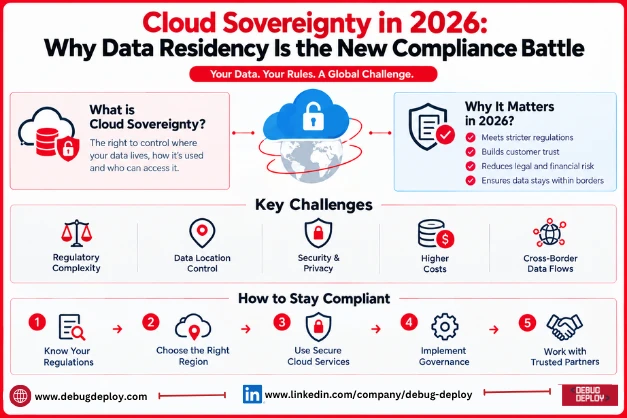
The way businesses store, handle, and retrieve business data has changed as a result of cloud usage. However, governments and regulators are paying increasing attention to where data is stored, where it is processed, and who may access it as more sensitive data migrates into cloud environments.
Cloud sovereignty and data residency are becoming more popular as a result.
Cloud compliance is becoming more than just data protection for multinational corporations. Additionally, companies must comprehend any operational, legal, geographical, and access restrictions that may be relevant to their cloud workloads.
By 2026, cloud sovereignty will be a significant factor for businesses planning foreign data strategies, choosing cloud providers, and creating cloud architectures.
What Is Cloud Sovereignty?
Cloud sovereignty refers to an organization’s ability to maintain control over its data, applications, infrastructure, and digital operations according to applicable national or regional laws and requirements.
Cloud sovereignty can involve several dimensions:
Data sovereignty
Data residency
Operational sovereignty
Technology sovereignty
Legal and regulatory control
Access control
The exact requirements vary by country, industry, and type of data.
Cloud sovereignty is therefore broader than simply choosing a data center in a particular country.
What Is Data Residency?
Data residency refers to the geographic location where data is stored or processed.
For example, an organization may have a requirement that certain customer or government data remain within a particular country or economic region.
Data residency requirements can affect:
Cloud storage
Databases
Backup systems
Disaster recovery
Data processing
Analytics
AI workloads
Logging and monitoring
Organizations need to understand where data actually moves rather than focusing only on the physical location of the primary database.
Data Residency vs Data Sovereignty
The terms are related but not identical.
Concept | Meaning |
Data residency | Where data is physically stored or processed |
Data sovereignty | Which laws and jurisdictional controls apply to data |
Data localization | Requirements that certain data remain within a specified jurisdiction |
Cloud sovereignty | Broader control over data, infrastructure, operations, and access |
For example, data may be stored inside a country while still being accessed or managed by organizations operating from another jurisdiction.
This is why organizations need to examine their complete cloud architecture.
Why Cloud Sovereignty Matters in 2026
Several factors are increasing the importance of sovereignty.
1. Increasing Data Regulations
Globally, governments and authorities are creating regulations pertaining to data processing, transfers, security, and privacy.
As a result, businesses that operate globally must comprehend the regulations that apply to each market in which they do business.
2. Growth of AI Workloads
AI systems are capable of processing vast amounts of personal and business data.
The processing and storage locations of prompts, documents, training data, outputs, logs, and other data must be understood by organizations utilizing generative AI, machine learning, analytics, or AI agents.
3. Cross-Border Data Transfers
Multiple services and geographical areas are frequently involved in cloud applications.
A workload may use monitoring, backup, analytics, or AI services in one area while storing data in another.
It is becoming more and more crucial for cloud architects and compliance teams to comprehend these data flows.
4. Critical Infrastructure
Government, healthcare, financial services, telecommunications, and other sensitive sectors may face additional requirements related to data protection and operational control.
What Is a Sovereign Cloud?
A sovereign cloud is designed to provide additional controls over data location, access, operations, and jurisdiction.
Depending on the provider and use case, sovereign cloud offerings may include capabilities related to:
Data residency
Restricted administrative access
Local operational controls
Encryption
Identity management
Regulatory compliance
Auditability
Controlled data transfers
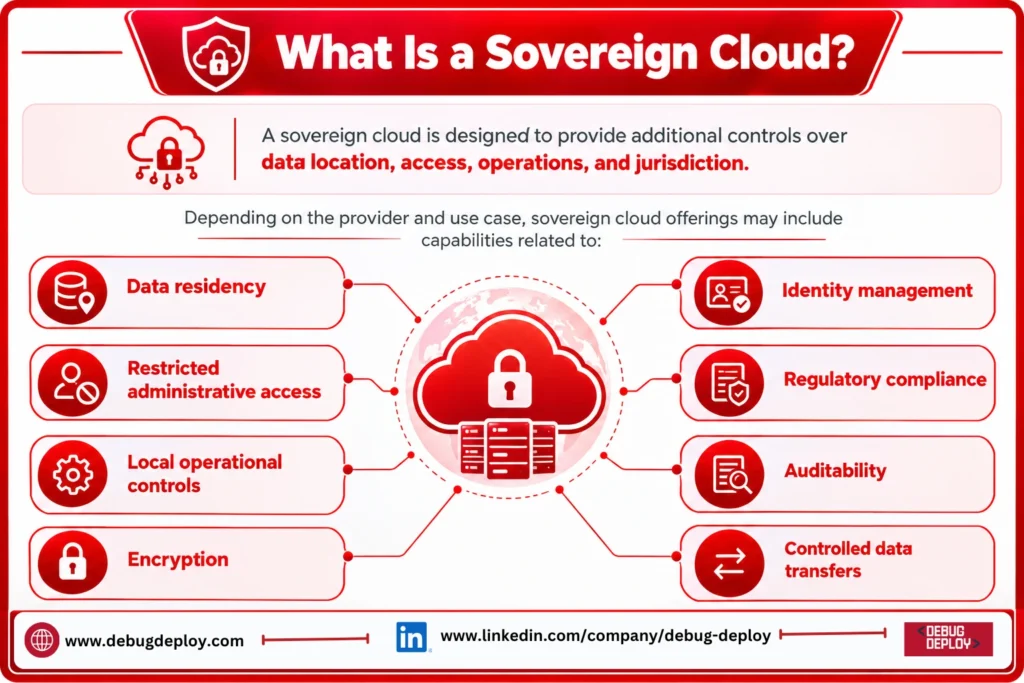
The specific controls vary between providers and jurisdictions.
Organizations should therefore evaluate the actual contractual, technical, and operational controls rather than assuming that a product labeled “sovereign” automatically satisfies every regulatory requirement.
How Cloud Sovereignty Changes Cloud Architecture
Traditional cloud architecture often emphasizes scalability, availability, performance, and cost.
A sovereignty-aware architecture adds another design question:
Where can every component of this workload legally and operationally exist?
Consider an application architecture:
Users → Application → API → Database → Analytics → Backup → Monitoring
A sovereignty review may examine the geographic and jurisdictional location of every component.
For example:
Where is the primary database?
Where are backups stored?
Where are logs retained?
Where does encryption key management occur?
Where are support operations performed?
Can administrators access the environment remotely?
Where does AI processing occur?
Are data transfers between regions permitted?
This can make cloud architecture more complex but also more transparent.
Cloud Sovereignty and AI
AI introduces additional sovereignty considerations.
A generative AI application may process:
User Prompt → Application → AI Model → Enterprise Data → AI Response
Each stage can potentially involve data processing.
Organizations should determine:
Where prompts are processed
Where data is stored
Whether information is retained
Where model inference occurs
Where logs are stored
Who can access the data
Whether data is transferred internationally
This is particularly important when AI applications process confidential business information, personal information, financial records, intellectual property, or government data.
How Businesses Can Prepare for Data Residency Requirements
Organizations can take a structured approach.
1. Map Data Flows
Document where data is collected, processed, stored, backed up, analyzed, and transferred.
2. Classify Data
Not every dataset requires the same controls.
Classify information according to business sensitivity and applicable legal or regulatory requirements.
3. Define Geographic Requirements
Determine which workloads need to remain within specific countries or regions.
4. Review Cloud Services
Do not evaluate only the primary cloud region. Review connected services, backups, monitoring, support, AI services, and data-processing locations.
5. Strengthen Identity and Access Controls
Use least-privilege access, strong authentication, encryption, and appropriate administrative controls.
6. Review Contracts and Provider Commitments
Technical architecture alone does not determine compliance. Organizations should also review provider terms, data-processing agreements, service documentation, and relevant contractual commitments with legal and compliance teams.
Cloud Sovereignty Challenges
Implementing sovereignty requirements can introduce several challenges.
Higher Costs
Restricting workloads to specific regions can reduce infrastructure flexibility and potentially increase costs.
Reduced Service Availability
Some cloud services or features may not be available in every geographic region.
Architecture Complexity
Organizations may need separate environments for different jurisdictions.
AI and Data Integration
Cross-region analytics and AI workloads may require additional controls and architectural planning.
Vendor Evaluation
Businesses need to examine not only cloud infrastructure but also third-party SaaS, AI, security, analytics, and monitoring services.
Cloud Sovereignty Checklist for 2026
Before deploying a sensitive workload, organizations can ask:
Where is the data stored?
Where is it processed?
Where are backups located?
Where are encryption keys managed?
Who can access the environment?
Where are logs stored?
Does the application transfer data internationally?
Where does AI inference occur?
What third-party services receive the data?
What contractual controls apply?
Which regulations apply to the specific dataset and business activity?
These questions can help organizations identify sovereignty risks before deployment.
Conclusion
In contemporary cloud architecture, cloud sovereignty is increasingly being taken into account.
The larger picture of sovereignty includes more than just data residence. Jurisdiction, administrative access, operational control, data transfers, encryption, AI processing, backups, and third-party services are additional factors that organizations need to take into account.
Sovereignty should not be viewed as a post-deployment compliance issue, but rather as a factor in architecture and vendor selection for companies creating their cloud strategy for 2026.
Organizations may learn where their data travels, who can access it, and which policies apply to their cloud environment with the aid of a well-crafted sovereignty strategy.
Maintaining adequate control over data and digital processes will continue to be crucial for safe and compliant cloud transition as cloud computing and AI become more widespread.
Want to Master Cloud Sovereignty & Data Residency for 2026?
Learn how to design secure, compliant, and resilient cloud environments that address data residency, regulatory requirements, governance, and data protection across global cloud platforms. Build practical skills in Microsoft Azure architecture, security, compliance, data governance, and cloud sovereignty with guidance from a Microsoft Certified Trainer (MCT).
Recommended Microsoft Azure, Security & Data Certification Programs:
AZ-305: Designing Microsoft Azure Infrastructure Solutions
AZ-104: Microsoft Azure Administrator
AZ-900: Microsoft Azure Fundamentals
DP-900: Microsoft Azure Data Fundamentals
Live Instructor-Led Training
Cloud Sovereignty & Data Residency Concepts
Azure Security, Compliance & Governance
Data Protection & Regulatory Requirements
Secure Multi-Region & Hybrid Cloud Architecture
Real-World Cloud Security & Governance Projects
Certification Preparation & Career Guidance
– Email: trainings@debugdeploy.com
– WhatsApp: Contact us for quick assistance
Build your cloud sovereignty expertise and learn how to design secure, compliant, and resilient cloud environments that address data residency and regulatory requirements across global markets in 2026.