
Cloud computing has completely changed how businesses create and manage apps. However, managing cloud spending is getting harder as companies embrace generative AI, machine learning, artificial intelligence, and data-intensive workloads.
Organisations in 2026 will require more than just conventional methods of cost reduction. They require an organised strategy that links the business, finance, and technology departments.
FinOps becomes crucial in this situation.
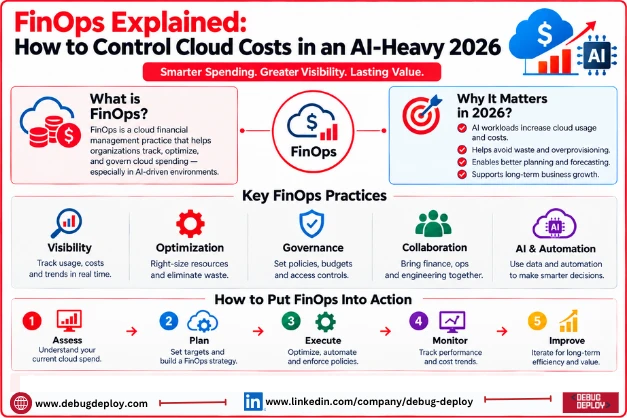
Financial Operations, or FinOps for short, is a framework that helps businesses optimize the business value of their cloud expenditures while controlling cloud expenses. FinOps may assist teams in identifying unproductive workloads, understanding where cloud spending is going, and making well-informed decisions about infrastructure and AI utilisation in an AI-heavy environment.
What Is FinOps?
FinOps is a cloud financial management practice that helps organizations understand, manage, and optimize technology spending.
Rather than treating cloud costs as only an IT responsibility, FinOps encourages collaboration between:
Engineering teams
IT and cloud teams
Finance teams
Procurement
Business leaders
Data and AI teams
The objective is not simply to spend less.
Instead, FinOps focuses on achieving the right balance between cost, performance, scalability, and business value.
For example, reducing an AI workload’s compute resources may lower the bill but could also reduce application performance. A FinOps approach considers both the financial and technical impact before making optimization decisions.
Why FinOps Matters More in 2026
AI is changing cloud consumption patterns.
Traditional applications may have relatively predictable compute and storage requirements. AI workloads can be much more dynamic.
Organizations may incur costs from:
GPU and specialized compute
Model training
Model inference
AI APIs
Vector databases
Data storage
Data processing
Real-time pipelines
AI agents
Model monitoring
Large-scale experimentation
As AI adoption increases, cloud spending can grow quickly if workloads are not monitored and governed effectively.
This makes AI FinOps an increasingly important part of a modern cloud strategy.
How AI Changes Cloud Cost Management
AI workloads introduce several cost-management challenges.
1. GPU Costs
AI model training and some inference workloads require specialized accelerators such as GPUs.
These resources can be significantly more expensive than conventional CPU-based infrastructure.
Teams should therefore monitor GPU utilization and determine whether resources are being used efficiently.
2. Model Inference Costs
AI applications may make thousands or millions of model requests.
For production AI systems, the cost of individual requests can become an important operational metric.
Organizations should track factors such as:
Number of requests
Tokens processed
Model selection
Response size
Processing time
Cost per request
3. Data Processing
AI applications often require large amounts of data.
Moving, transforming, storing, and processing that data can create additional cloud costs.
A well-designed data architecture can therefore play an important role in FinOps.
4. AI Experimentation
Development teams may test multiple models, prompts, configurations, and architectures.
Without appropriate controls, experimentation can create unexpected cloud spending.
FinOps practices can help teams establish budgets, usage monitoring, and accountability.
Core Principles of FinOps
A successful FinOps strategy generally involves three important areas.
1. Visibility
Organizations need to understand where cloud money is being spent.
Cloud bills should be connected to meaningful dimensions such as:
Business unit
Application
Project
Environment
Customer
Department
AI workload
Resource tagging and consistent naming conventions can improve cost visibility.
2. Optimization
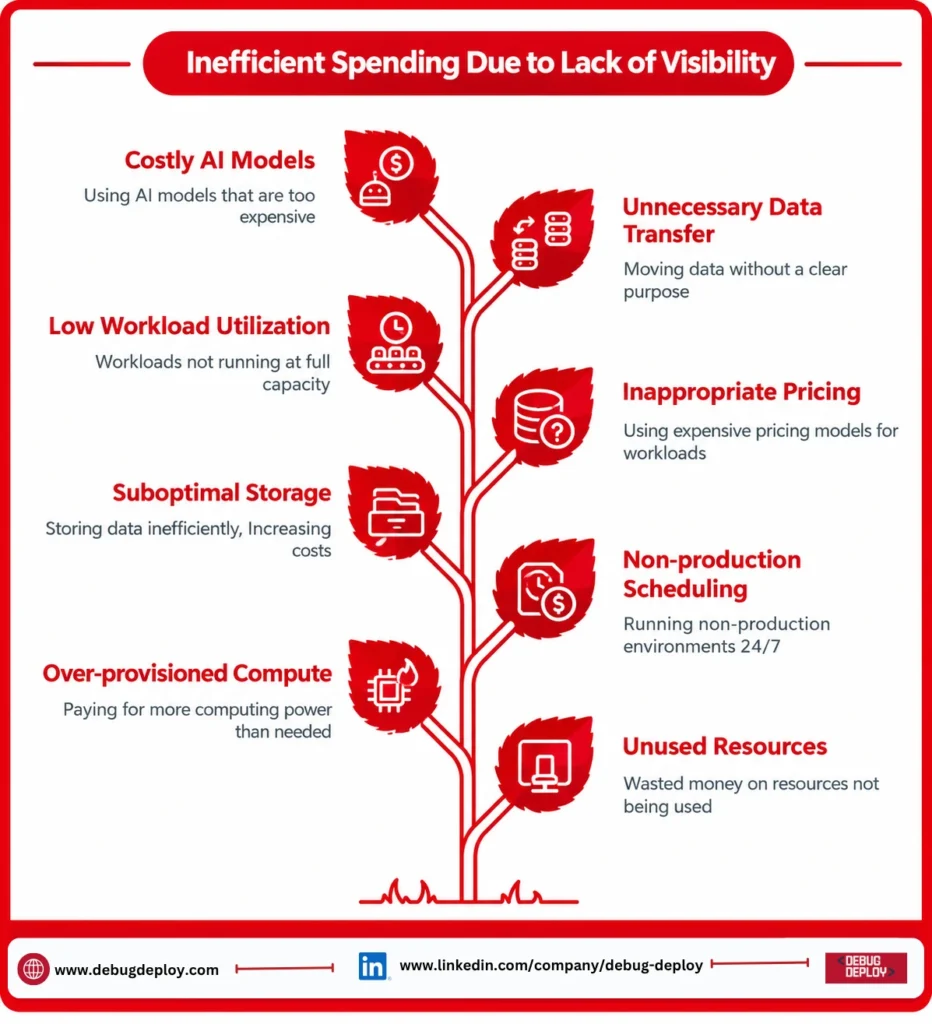
Once spending is visible, teams can identify opportunities to improve efficiency.
Examples include:
Removing unused resources
Right-sizing compute
Scheduling non-production environments
Optimizing storage
Selecting appropriate pricing models
Improving workload utilization
Reducing unnecessary data transfer
Selecting cost-effective AI models
Optimization should not compromise required performance, reliability, or security.
3. Accountability
Teams should understand how their technology decisions affect cloud spending.
Engineering teams can monitor the financial impact of architecture decisions, while finance teams gain better visibility into technology investments.
This creates shared responsibility for cloud costs.
FinOps Strategies for AI Workloads
Organizations can apply several techniques to manage AI-related cloud costs.
Use the Right AI Model
Not every task requires the largest or most expensive model.
For simple classification, summarization, extraction, or automation tasks, a smaller model may be sufficient.
Model selection should consider both capability and cost.
Optimize Inference
Production inference can become a significant recurring expense.
Organizations can evaluate:
Request frequency
Model size
Context length
Caching
Batch processing
Response limits
Model routing
The goal is to deliver the required application experience without unnecessary resource consumption.
Monitor GPU Utilization
Expensive compute resources should be monitored closely.
Low utilization can indicate that workloads need better scheduling, scaling, batching, or resource allocation.
Separate Development and Production Costs
AI experimentation can make it difficult to understand production spending.
Separating environments can help organizations identify where costs originate and establish appropriate budgets.
Building a FinOps Strategy in 2026
A practical FinOps program can begin with a few foundational steps.
Step 1: Establish Cloud Cost Visibility
Connect cloud billing data with applications, projects, teams, and business units.
Step 2: Create Consistent Tagging
Use standardized tags for environments, departments, applications, and workloads.
Step 3: Define Budgets
Create budgets and spending thresholds for major cloud and AI workloads.
Step 4: Monitor AI-Specific Metrics
Track GPU usage, model consumption, inference requests, storage, data processing, and API usage.
Step 5: Automate Optimization
Use automated policies to identify idle resources, recommend right-sizing, and manage non-production environments.
Step 6: Measure Business Value
Cloud cost should be evaluated alongside business outcomes.
For example, organizations could track:
Cost per AI request → Cost per customer → Cost per transaction → Business value generated
This provides a more meaningful view than looking only at the monthly cloud bill.
FinOps vs Traditional Cloud Cost Optimization
Traditional cloud cost optimization often focuses primarily on reducing infrastructure expenses.
FinOps takes a broader approach.
Traditional Cost Optimization | FinOps |
Focuses on reducing costs | Focuses on cost and business value |
Primarily IT-driven | Cross-functional |
Periodic reviews | Continuous management |
Infrastructure focused | Infrastructure + applications + AI |
Monthly bill analysis | Continuous visibility |
Manual optimization | Increasing automation |
Common FinOps Mistakes to Avoid
Organizations can undermine their FinOps efforts by focusing only on cost reduction.
Common mistakes include:
Cutting resources without considering performance
Ignoring AI inference costs
Failing to tag cloud resources
Treating finance and engineering as separate functions
Ignoring data transfer expenses
Allowing unlimited AI experimentation
Focusing only on monthly bills
Failing to establish ownership
Effective FinOps should support informed technology decisions rather than simply restricting cloud usage.
The Future of FinOps in an AI-Driven Cloud
As AI becomes more deeply integrated into enterprise applications, FinOps is likely to expand beyond conventional cloud infrastructure.
Organizations will increasingly need visibility into the financial impact of:
Cloud Infrastructure + Data + AI Models + APIs + Applications + Agents
This means cloud architects, developers, finance teams, and AI teams will need to work together.
AI itself can also assist FinOps by identifying unusual spending patterns, recommending optimization opportunities, forecasting usage, and automating resource-management tasks.
Conclusion
In an AI-heavy 2026, FinOps is becoming a crucial component of cloud strategy.
Cloud spending can grow more unpredictable as businesses use GPUs, generative AI, intelligent applications, and large-scale data platforms.
A solid FinOps approach links technology investment with business results, promotes responsible resource management, and gives visibility into cloud consumption.
Reducing the cloud bill is not the only objective. Ensuring that every cloud and AI investment yields suitable performance, efficiency, scalability, and business value is the aim.
Combining cloud architecture, AI governance, data management, and FinOps may strengthen the basis for long-term digital transformation for businesses implementing AI at scale.
Want to Master FinOps & Cloud Cost Optimization for an AI-Heavy 2026?
Learn how to manage, optimize, and control cloud spending across modern AI and cloud environments with Microsoft Azure training from a Microsoft Certified Trainer (MCT). Build practical skills in cloud cost management, resource optimization, governance, monitoring, and AI workload cost optimization.
Recommended Microsoft Azure, Cloud & Data Certification Programs:
AZ-305: Designing Microsoft Azure Infrastructure Solutions
AZ-104: Microsoft Azure Administrator
AZ-900: Microsoft Azure Fundamentals
DP-900: Microsoft Azure Data Fundamentals
Live Instructor-Led Training
FinOps & Cloud Cost Management Skills
Azure Cost Optimization & Resource Governance
AI Workload Cost Optimization
Cloud Monitoring, Budgeting & Cost Control
Real-World Cloud & FinOps Projects
Certification Preparation & Career Guidance
– Email: trainings@debugdeploy.com
– WhatsApp: Contact us for quick assistance
Build your FinOps and cloud cost optimization expertise to control AI-driven cloud spending while improving resource efficiency, governance, scalability, and business value in 2026.