
A crucial component of contemporary corporate infrastructure is cloud computing. But picking the best cloud deployment approach now involves more than just picking a provider. Companies must choose how to divide their workloads, infrastructure, data, and apps among on-premises systems, private environments, and public clouds.
Multi-cloud and hybrid cloud are two frequently debated strategies.
Although the terms are sometimes used synonymously, they refer to distinct cloud techniques. Organisations may make better decisions in 2026 regarding scalability, security, compliance, cost management, and application modernisation by knowing the differences between multi-cloud and hybrid cloud.
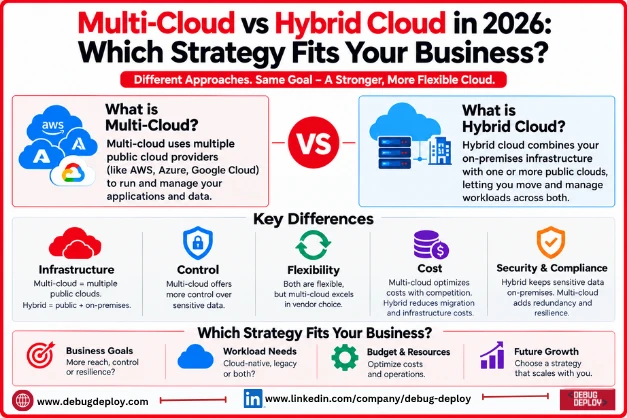
What Is Multi-Cloud?
Multi-cloud means using cloud services from two or more cloud providers.
For instance, a company may employ Google Cloud for particular AI or machine learning workloads, Amazon Web Services (AWS) for application hosting, and Microsoft Azure for analytics.
Business Applications → Azure + AWS + Google Cloud
The primary characteristic is the use of multiple cloud providers.
Organizations may adopt multi-cloud strategies for several reasons, including access to specialized services, geographic availability, workload requirements, or business continuity.
Common Multi-Cloud Use Cases
Businesses may use multi-cloud for:
AI and machine learning workloads
Application modernization
Data analytics
Global application deployment
Disaster recovery
Specialized cloud services
Business continuity
Avoiding dependence on a single cloud provider
What Is a Hybrid Cloud?
Hybrid cloud combines private infrastructure or on-premises environments with one or more public cloud platforms.
For example, an organization could keep sensitive databases in its private data center while running customer-facing applications in Azure or AWS.
A simplified hybrid cloud architecture might look like:
On-Premises / Private Cloud ↔ Public Cloud
The environments are connected so applications and data can work across both locations.
Hybrid cloud is particularly relevant for organizations that need to maintain existing infrastructure while gradually adopting cloud services.
Common Hybrid Cloud Use Cases
Hybrid cloud is often considered for:
Regulated workloads
Legacy application modernization
Data residency requirements
Private data processing
Cloud bursting
Disaster recovery
Gradual cloud migration
Organizations with significant existing infrastructure
Multi-Cloud vs Hybrid Cloud: Key Differences
Although both strategies can involve multiple environments, their objectives are different.
Factor | Multi-Cloud | Hybrid Cloud |
Cloud providers | Usually two or more | One or more public clouds |
On-premises infrastructure | Not required | Usually part of the architecture |
Main focus | Multiple cloud providers | Integration of private and public environments |
Provider flexibility | High | Depends on architecture |
Legacy integration | Not the primary objective | Often important |
Data location | Multiple cloud environments | Private + public environments |
Complexity | Can increase with every provider | Can increase due to integration |
Common goal | Flexibility and specialized services | Cloud modernization and workload integration |
Which Strategy Is Better for Your Business?
There is no single cloud strategy that fits every organization.
The right choice depends on your applications, data requirements, regulatory environment, existing infrastructure, technical capabilities, and business objectives.
Choose Multi-Cloud When You Need Provider Flexibility
A multi-cloud strategy may make sense when different cloud providers offer services that align with different workloads.
For example:
Azure for Microsoft-centric enterprise environments
AWS for broad infrastructure and application services
Google Cloud for specific data, analytics, or AI capabilities
However, using multiple providers also introduces additional management, networking, security, monitoring, and skills requirements.
Choose Hybrid Cloud When You Need to Connect Existing Infrastructure With the Cloud
When a company is unable or unwilling to transfer all of its workload to the public cloud, hybrid cloud may be the best option.
For instance, a company may transfer scalable apps and analytics services to a public cloud while keeping sensitive workloads on-site.
Instead of necessitating an instantaneous migration of all systems, this might allow a strategy of incremental modernisation.
Multi-Cloud vs Hybrid Cloud for Security
Security requirements might have a big impact on the choice.
Organisations that use different cloud providers must have uniform security practices. It may be necessary for identity management, access restrictions, logging, network security, and compliance monitoring to function across several platforms.
Securing connectivity between private infrastructure and public cloud environments is another difficulty brought about by hybrid cloud.
Regardless of the approach they use, businesses should think about centralised identity, encryption, network segmentation, security monitoring, and policy administration.
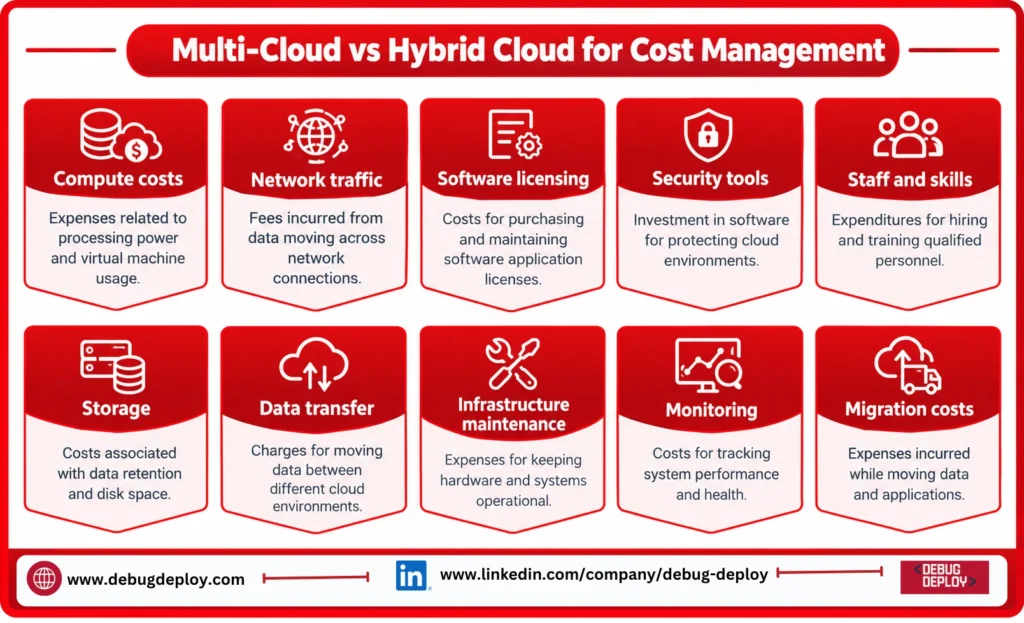
Multi-Cloud vs Hybrid Cloud for Cost Management
In both models, cost control can become challenging.
Different pricing models, billing structures, data transfer charges, and resource-management procedures among providers may result from multi-cloud settings.
Both the ongoing costs of maintaining private infrastructure and cloud running costs may be included in a hybrid cloud.
Instead of only comparing cloud service rates, companies should assess total cost of ownership for a 2026 cloud strategy.
Consider:
Compute costs
Storage
Network traffic
Data transfer
Software licensing
Infrastructure maintenance
Security tools
Monitoring
Staff and skills
Migration costs
Which Strategy Supports Cloud Migration Better?
The answer depends on the starting point.
For organizations with substantial on-premises infrastructure, hybrid cloud can provide a transition path.
Instead of moving everything at once, businesses can:
Assess → Connect → Migrate → Modernize → Optimize
Some workloads can remain on-premises while others move to public cloud platforms.
Multi-cloud, on the other hand, can become relevant when organizations deliberately distribute workloads across multiple cloud providers.
The two strategies can also coexist.
For example, a company could have:
On-Premises + Azure + AWS
This environment would combine hybrid and multi-cloud characteristics.
Challenges to Consider in 2026
Before selecting either strategy, organizations should understand the operational challenges.
1. Management Complexity
Every additional environment can increase the number of tools, processes, policies, and skills required.
2. Data Integration
Moving data between environments can introduce latency, security, and cost considerations.
3. Skills Requirements
Teams may need expertise across cloud platforms, networking, security, DevOps, data engineering, and cloud architecture.
4. Governance
Organizations need consistent policies for identity, security, compliance, resource management, and data governance.
5. Application Architecture
Applications should be designed with the target cloud environment in mind. Poorly designed dependencies can make multi-cloud or hybrid architectures unnecessarily complex.
How to Choose a Cloud Strategy in 2026
Before deciding between multi-cloud and hybrid cloud, ask these questions:
Do we need to retain on-premises infrastructure?
Are there regulatory or data residency requirements?
Do different cloud providers offer important capabilities for our workloads?
What applications are ready for migration?
How much cloud management complexity can our team support?
What are our security and governance requirements?
What is our long-term application modernization strategy?
How will we monitor and control cloud costs?
The answers can help determine whether multi-cloud, hybrid cloud, or a combination of both is appropriate.
Multi-Cloud vs Hybrid Cloud: A Strategic View
The distinction is simple:
Multi-cloud focuses on using multiple cloud providers. Hybrid cloud focuses on integrating public cloud with private or on-premises infrastructure.
In 2026, organizations may increasingly use combinations of these approaches as cloud architectures become more distributed.
The important consideration is not simply how many clouds an organization uses. It is whether the architecture supports business requirements without introducing unnecessary complexity.
Conclusion
The choice between a multi-cloud and hybrid cloud should be made based on business needs rather than just cloud trends.
While hybrid cloud can assist organisations in integrating their current infrastructure with public cloud services, multi-cloud can offer access to capabilities across many providers.
Building an architecture that strikes a balance between scalability, security, flexibility, performance, governance, and affordability should be the main goal for companies designing their cloud strategy for 2026.
Additionally, a well-thought-out cloud strategy can change over time. Businesses can start with a hybrid cloud, use multi-cloud capabilities when necessary, and update their infrastructure and apps on a regular basis as their needs evolve.
Are you preparing to move to the cloud? Before choosing a cloud deployment option, assess your current infrastructure, application portfolio, data architecture, security needs, and long-term business objectives.
Want to Master Multi-Cloud & Hybrid Cloud Strategies for Your 2026 Business?
Learn how to design and manage flexible, scalable, and secure multi-cloud and hybrid cloud environments with Microsoft Azure training from a Microsoft Certified Trainer (MCT). Build practical skills in cloud architecture, workload integration, migration, security, governance, and cost optimization.
Recommended Microsoft Azure, Cloud & Data Certification Programs:
AZ-305: Designing Microsoft Azure Infrastructure Solutions
AZ-104: Microsoft Azure Administrator
AZ-900: Microsoft Azure Fundamentals
DP-900: Microsoft Azure Data Fundamentals
Live Instructor-Led Training
Multi-Cloud & Hybrid Cloud Architecture Skills
Azure, AWS & GCP Cloud Integration
Cloud Migration, Security & Governance
Real-World Cloud Architecture Projects
Certification Preparation & Career Guidance
– Email: trainings@debugdeploy.com
– WhatsApp: Contact us for quick assistance
Build your multi-cloud and hybrid cloud expertise and learn how to design secure, scalable, and cost-effective cloud environments aligned with your organization’s 2026 business and technology strategy.