

Introduction
Applications, websites, consumer interactions, financial systems, IoT devices, and corporate activities all produce massive amounts of data for modern enterprises. It takes more than just conventional databases to transform this data into insightful knowledge. Scalable cloud data warehouse solutions that can handle massive datasets, handle analytics workloads, and interface with contemporary data engineering and business intelligence tools are essential for organizations.
Microsoft Azure Synapse Analytics and Amazon Redshift are two significant cloud data warehouse platforms. Although they take distinct approaches to architecture, pricing, integration, and workload management, both are intended to assist enterprises in storing, processing, and analyzing massive amounts of data.
Choosing between AWS Redshift and Azure Synapse depends on your existing cloud environment, data sources, analytics requirements, technical skills, and budget. In this guide, we’ll compare AWS Redshift vs Azure Synapse across features, architecture, performance, pricing, scalability, security, integrations, and use cases.
AWS Redshift vs Azure Synapse at a Glance
Feature | Amazon Redshift | Azure Synapse Analytics |
Cloud Provider | AWS | Microsoft Azure |
Primary Purpose | Cloud data warehousing and analytics | Data warehousing, analytics, and data integration |
Best For | AWS-centric organizations | Azure and Microsoft ecosystem users |
Architecture | Massively parallel processing | Dedicated and serverless SQL options |
BI Integration | Amazon QuickSight and third-party BI tools | Power BI and third-party BI tools |
Data Integration | AWS Glue and other AWS services | Azure Data Factory and Synapse pipelines |
Serverless Options | Available | Available |
Security | IAM, encryption, VPC controls | Microsoft Entra ID, Azure security services |
Analytics | SQL, BI, machine learning integrations | SQL, Spark, BI, data engineering |
What Is Amazon Redshift?
AWS offers a fully managed cloud data warehousing service called Amazon Redshift. It is intended to use SQL to evaluate massive volumes of semi-structured and structured data.
Redshift distributes workloads among several computational resources thanks to its massively parallel processing architecture. Because of this, it can be used for intricate analytical queries involving big datasets.
Redshift is frequently used by organizations for large-scale data warehousing, reporting, data analytics, operational analytics, and business intelligence.
Redshift is especially appealing to businesses who currently use Amazon S3, AWS Glue, Amazon EMR, Amazon SageMaker, and other AWS technologies since it connects with other AWS services.
What Is Azure Synapse Analytics?
Microsoft’s cloud analytics platform, Azure Synapse Analytics, integrates analytics, big data processing, data integration, and data warehousing into a single environment.
For large-scale data engineering and data science workloads, Synapse offers serverless SQL for data querying without maintaining dedicated infrastructure, dedicated SQL pools for data warehousing, and Apache Spark-based analytics.
Organizations working within the Microsoft ecosystem find it especially appealing due to its interaction with services like Azure Data Lake Storage, Microsoft Power BI, Azure Machine Learning, and Microsoft Fabric-related technologies.
AWS Redshift vs Azure Synapse: Architecture
One of the most significant distinctions between the two systems is their architecture.
The distributed data warehouse architecture is the main foundation of Amazon Redshift. To efficiently handle queries, analytical workloads are spread across computational resources. For businesses who wish to avoid managing dedicated warehouse capacity, AWS also offers serverless capabilities.
Azure Synapse adopts a more comprehensive analytics strategy. It integrates serverless SQL, Apache Spark, dedicated SQL pools, and data integration features. This enables businesses to manage big data engineering and analytics duties in addition to regular data warehouse responsibilities.
Simple Architecture View
Amazon Redshift
Data Sources
↓
Amazon S3 / Applications
↓
Amazon Redshift
↓
SQL Analytics
↓
BI / Reporting
Azure Synapse
Data Sources
↓
Azure Data Lake
↓
Azure Synapse
┌────┼─────┐
↓ ↓ ↓
SQL Spark Pipelines
↓ ↓ ↓
Analytics & BI
Performance Comparison
Workload design, data volume, query complexity, data distribution, indexing or storage techniques, concurrency, and configuration all have a significant impact on performance.
When tables and workloads are properly structured, Amazon Redshift may provide robust performance for complicated SQL queries and is geared for large-scale analytical workloads. Large datasets may be analyzed in parallel because of its distributed architecture.
Massively parallel data warehousing applications are also supported by Azure Synapse via specialized SQL pools. Businesses dealing with both structured and large data workloads may find its ability to integrate SQL analytics with Spark useful.
Organizations should use their own datasets and queries to benchmark both platforms rather than asking which is generally faster.
Pricing Comparison
Another important factor to take into account when contrasting AWS Redshift vs Azure Synapse is price.
Depending on the deployment model and capacity needs, Amazon Redshift offers a variety of pricing strategies. Depending on their workload patterns, organizations can select serverless capabilities or supplied resources.
In a similar vein, Azure Synapse offers many consumption models. While serverless SQL can be helpful for querying data without maintaining dedicated warehouse infrastructure, dedicated SQL pools are typically better suited for predictable workloads needing reserved analytical capacity.
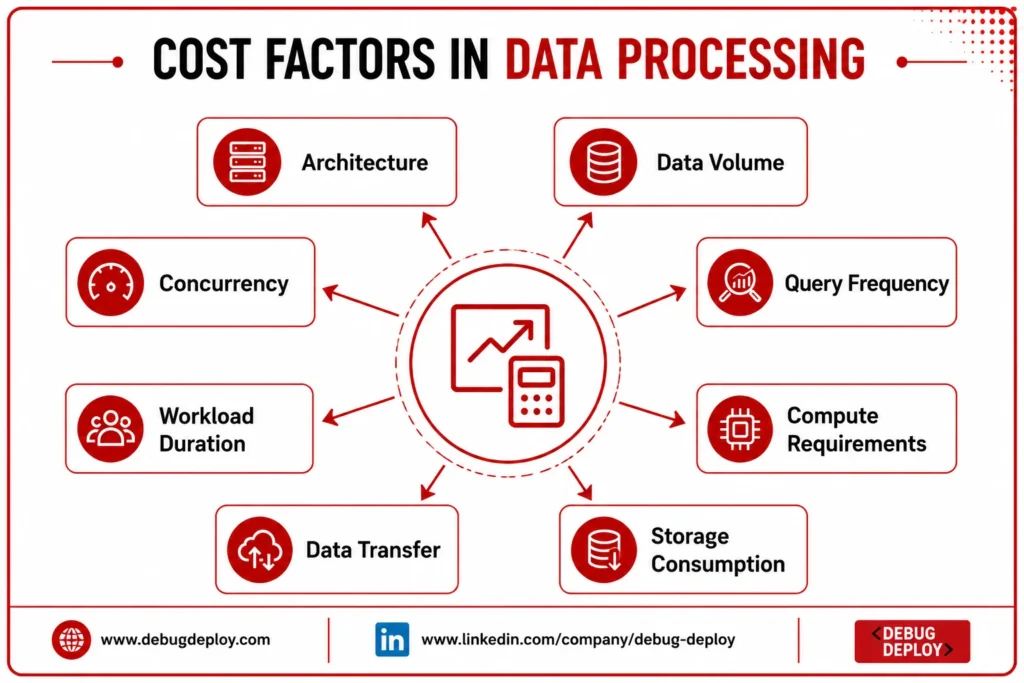
The actual cost depends on factors such as:
Data volume
Query frequency
Compute requirements
Storage consumption
Data transfer
Workload duration
Concurrency
Dedicated vs serverless architecture
For this reason, comparing only the advertised computer price is not enough. Businesses should calculate their expected monthly workload before making a decision.
Data Integration
Another area in which the systems vary is data integration.
AWS services like Amazon S3 and AWS Glue are easily integrated with Amazon Redshift. Pipelines that transport and transform data before loading it into Redshift can be built by organizations who already have AWS data lakes.
Azure Data Factory and Azure Data Lake Storage are tightly integrated with Azure Synapse. This enables businesses to input analytical data into Synapse, change datasets, and build data pipelines.
Redshift can provide a more straightforward integration route if your company currently has a sizable AWS data platform. Synapse can offer a similarly integrated experience if your company uses Azure services extensively.
Business Intelligence Integration
One of the main reasons businesses use cloud data warehouses is for business intelligence.
Numerous third-party BI solutions and Amazon QuickSight are integrated with Amazon Redshift. This makes it appropriate for businesses with a broad BI setup or those that currently utilize AWS analytics products.
Microsoft Power BI and Azure Synapse are especially well-integrated. Businesses may easily link their analytical operations to the Microsoft environment by utilizing Power BI for dashboards and reporting.
Azure Synapse can provide a practical architecture for integrating enterprise data warehousing with business intelligence for companies that have previously standardized on Power BI.
Security Comparison
Enterprise-level security features are offered by both platforms.
Network controls, monitoring, encryption, AWS Identity and Access Management, and other AWS security services are all integrated with Amazon Redshift. By using encryption and auditing, organizations can manage access to infrastructure and data.
Microsoft Entra ID, Azure Role-Based Access Control, encryption, Azure Key Vault, Microsoft Defender, and many Azure security services are all integrated with Azure Synapse.
The current identity, governance, and security architecture of your company will determine which option is best.
Scalability
Large analytical workloads can be accommodated by both platforms.
Redshift Serverless enables businesses to utilize analytical capabilities without having to manage provisioned warehouse capacity, while Redshift can expand compute capacity in accordance with workload requirements.
Both serverless SQL and scalable dedicated SQL pools are supported by Synapse. Additionally, its more comprehensive analytics architecture enables businesses to integrate Spark-based processing with SQL workloads.
Synapse’s integration of Spark and SQL might offer more flexibility for companies with intricate data engineering needs.
AWS Redshift vs Azure Synapse: Pros and Cons
Amazon Redshift
Advantages
Strong AWS ecosystem integration
Mature cloud data warehousing platform
Excellent support for analytical SQL workloads
Integration with Amazon S3
Serverless capabilities
Strong AWS security ecosystem
Considerations
Best experience often comes with AWS expertise
Additional AWS services may be required for complete data workflows
Cost management requires careful workload monitoring
Azure Synapse
Advantages
Strong Microsoft ecosystem integration
Integration with Power BI
Dedicated and serverless SQL options
Apache Spark support
Data integration capabilities
Strong Azure security and identity integration
Considerations
Can require multiple Azure services for advanced architectures
Dedicated capacity needs careful planning
Organizations may need expertise across SQL, Spark, and Azure data services
Which One Should You Choose?
The right choice depends on your existing environment and business requirements.
Choose Amazon Redshift if:
Your organization primarily uses AWS.
Your data already resides in Amazon S3.
You rely heavily on AWS analytics services.
Your primary requirement is cloud data warehousing.
Your team already has AWS data engineering expertise.
Choose Azure Synapse if:
Your organization primarily uses Microsoft Azure.
You use Power BI extensively.
Your data is stored in Azure Data Lake.
You need SQL and Spark analytics in one environment.
You want strong integration with Microsoft identity and security services.
Conclusion
Both Azure Synapse and AWS Redshift are robust cloud analytics and data warehouse systems. Because the best option relies on your company’s architecture, data demands, current cloud provider, analytics tools, technical know-how, and budget, neither is always superior.
For businesses with significant AWS investments searching for a scalable cloud data warehouse connected with services like Amazon S3 and AWS Glue, Amazon Redshift is a solid option. For Microsoft-focused companies looking to integrate Power BI, big data analytics, data warehousing, and data integration within the Azure environment, Azure Synapse is especially appealing.
Examine your current data architecture, project your anticipated workloads, go over security specifications, and benchmark representative queries before deciding. A platform that fits naturally into your existing ecosystem can often deliver better long-term value than simply choosing the platform with the lowest initial compute cost.
Want to Master Modern Cloud Data Warehousing with Microsoft Azure?
Learn how to design, manage, and optimize Azure data warehouse and analytics solutions with guidance from a Microsoft Certified Trainer (MCT). Build practical skills to support enterprise analytics, data engineering, cloud modernization, and AI-ready data platforms.
Recommended Microsoft Azure & Data Certification Programs:
AZ-900: Microsoft Azure Fundamentals
DP-900: Microsoft Azure Data Fundamentals
DP-203: Data Engineering on Microsoft Azure
DP-300: Administering Microsoft Azure SQL Solutions
✅ Live Instructor-Led Training
✅ Azure Synapse Analytics & Data Warehouse Skills
✅ Data Engineering & Analytics Concepts
✅ Cloud Data Architecture & Modernization Best Practices
✅ Data Security, Governance & Performance Optimization
✅ Certification Exam Preparation & Career Guidance
📧 Email: trainings@debugdeploy.com
📱 WhatsApp: Contact us for quick assistance
Build modern Azure data and analytics skills to design scalable, secure, and high-performance data platforms that support smarter business decisions and AI innovation.