
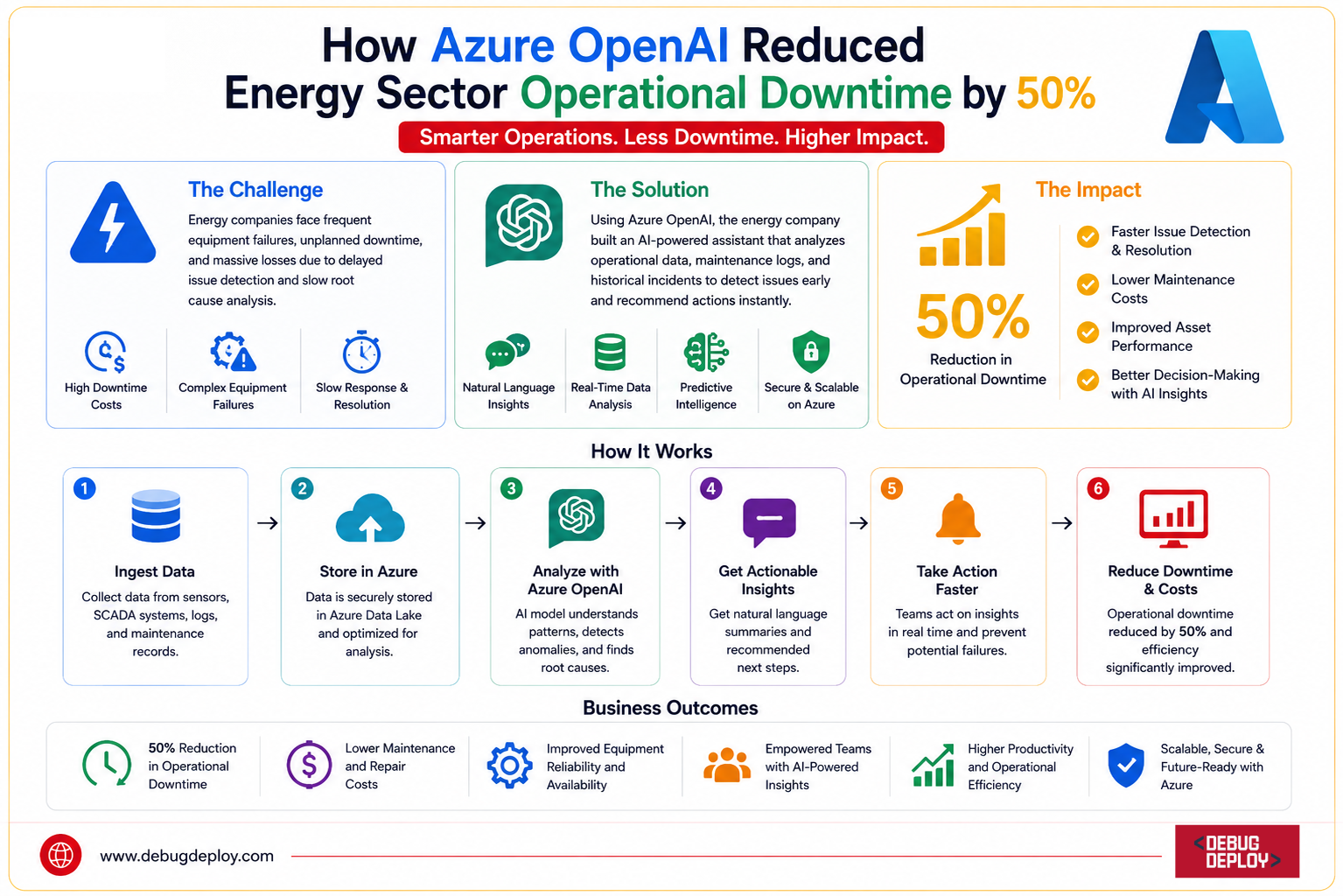
Every minute of downtime in the extremely demanding energy sector can lead to major financial losses, safety hazards, and operational interruptions. Organizations that oversee utility grids, power plants, oil and gas facilities, or renewable energy farms must constantly monitor intricate systems and react fast to equipment malfunctions.
Conventional monitoring techniques frequently depend on fragmented data sources, reactive maintenance, and manual inspections. Businesses are using artificial intelligence (AI) to increase operational efficiency and dependability as energy infrastructure grows more interconnected and data-rich.
Azure OpenAI Service is one of the most revolutionary technologies propelling this shift. Azure OpenAI is assisting energy firms in reducing operational downtime by up to 50%, enhancing asset performance, and optimizing maintenance strategies through the integration of advanced language models, predictive analytics, and real-time data processing.
Understanding the Downtime Challenge in the Energy Sector
Operational downtime occurs when critical equipment or systems become unavailable due to failures, maintenance activities, or unexpected disruptions.
Common causes include:
Equipment breakdowns
Pipeline failures
Power generation issues
Grid instability
Human error
Delayed maintenance actions
Inefficient troubleshooting processes
The consequences can be severe:
Production losses
Increased maintenance costs
Safety incidents
Regulatory compliance risks
Customer service disruptions
For large energy enterprises, even a single hour of downtime can cost thousands or millions of dollars depending on the operation.
The Role of Azure OpenAI in Modern Energy Operations
Azure OpenAI combines the capabilities of advanced AI models with Microsoft’s secure cloud infrastructure. Energy companies can leverage these technologies to analyze vast amounts of operational data and generate actionable insights in real time.
Key capabilities include:
Intelligent data analysis
Predictive maintenance recommendations
Natural language querying
Automated incident reporting
Knowledge management
Real-time decision support
Operational optimization
Instead of waiting for failures to occur, organizations can proactively identify risks and prevent disruptions before they impact operations.
Predictive Maintenance: The Biggest Driver of Downtime Reduction
One of the primary reasons Azure OpenAI helps reduce downtime is its ability to support predictive maintenance programs.
Traditional maintenance approaches typically fall into two categories:
Reactive Maintenance
Equipment is repaired only after failure occurs.
Challenges include:
Unexpected downtime
Higher repair costs
Emergency response requirements
Scheduled Maintenance
Equipment is serviced at predefined intervals regardless of actual condition.
Challenges include:
Unnecessary maintenance activities
Increased labor costs
Missed early warning signs
Azure OpenAI enables a third approach: Predictive Maintenance.
Using historical maintenance records, sensor readings, equipment logs, and operational data, AI models can identify patterns that indicate potential failures before they happen.
Benefits include:
Early fault detection
Reduced equipment failures
Better maintenance planning
Increased asset lifespan
Lower operational costs
This proactive approach significantly reduces unplanned downtime across energy facilities.
Real-Time Monitoring and Intelligent Alerts
Modern energy systems generate enormous volumes of data through IoT sensors, SCADA systems, smart meters, and industrial equipment.
The challenge is not collecting data—it’s interpreting it quickly.
Azure OpenAI helps organizations:
Analyze equipment performance data
Detect anomalies in real time
Identify operational risks
Prioritize critical alerts
Recommend corrective actions
Instead of overwhelming operators with thousands of notifications, AI highlights the most critical issues and provides contextual recommendations.
This enables faster response times and prevents small problems from becoming major outages.
Enhancing Incident Response
When failures occur, speed matters.
Traditional troubleshooting often requires engineers to:
Search maintenance records
Review technical documentation
Analyze logs manually
Consult multiple experts
This process can take hours.
Azure OpenAI dramatically accelerates incident response by acting as an intelligent operations assistant.
It can:
Summarize equipment histories
Retrieve relevant maintenance procedures
Analyze fault logs
Recommend troubleshooting steps
Generate incident reports automatically
Engineers spend less time searching for information and more time resolving issues.
The result is faster recovery and reduced downtime duration.
AI-Powered Knowledge Management
Many energy companies face a growing knowledge gap as experienced workers retire and workforce transitions occur.
Critical operational knowledge often exists in:
PDFs
Maintenance manuals
Engineering documents
Email archives
Historical reports
Azure OpenAI can transform these disconnected resources into an intelligent knowledge base.
Employees can ask questions in natural language such as:
“What caused the last turbine shutdown?”
“Show maintenance procedures for Pump A.”
“Which components frequently fail during summer operations?”
The AI instantly provides relevant answers, reducing dependency on institutional knowledge and improving operational consistency.
Optimizing Renewable Energy Operations
Renewable energy assets such as wind farms and solar plants require continuous monitoring to maximize performance.
Azure OpenAI helps operators:
Analyze weather patterns
Forecast energy production
Detect equipment degradation
Optimize maintenance schedules
Improve energy output
By identifying underperforming assets early, organizations can prevent productivity losses and improve overall operational efficiency.
This is especially valuable for geographically distributed renewable energy facilities.
Automating Operational Reporting
Reporting is essential in the energy industry for compliance, governance, and performance management.
However, generating reports manually consumes valuable time.
Azure OpenAI can automatically create:
Daily operational summaries
Maintenance reports
Incident documentation
Performance analyses
Compliance records
Automation reduces administrative workloads and allows engineers to focus on strategic activities.
It also improves reporting accuracy and consistency.
Real-World Impact: Achieving 50% Downtime Reduction
Organizations implementing Azure OpenAI-powered operational intelligence commonly experience significant improvements, including:
Up to 50% reduction in unplanned downtime
Faster fault detection
Improved asset reliability
Reduced maintenance costs
Enhanced workforce productivity
Better operational visibility
The combination of predictive maintenance, real-time monitoring, intelligent troubleshooting, and automated workflows creates a comprehensive framework for operational excellence.
Rather than reacting to failures, energy companies can anticipate and prevent disruptions before they occur.
Why Azure OpenAI Is Ideal for the Energy Sector
Several factors make Azure OpenAI particularly attractive for energy organizations:
Enterprise Security
Energy infrastructure often handles sensitive operational data.
Azure provides:
Enterprise-grade security
Identity management
Data encryption
Regulatory compliance support
Scalability
Whether managing a single facility or a global energy network, Azure OpenAI can scale to meet operational demands.
Integration with Existing Systems
Azure OpenAI integrates with:
SCADA platforms
ERP systems
IoT devices
Data warehouses
Microsoft Fabric
Power BI
This enables organizations to maximize value from existing technology investments.
Advanced Analytics
Combining Azure OpenAI with Azure Machine Learning, Power BI, and Microsoft Fabric creates a powerful analytics ecosystem capable of delivering deep operational insights.
Conclusion
Artificial intelligence is emerging as a major force behind operational excellence in the energy sector, which is going through a major digital revolution. Azure OpenAI provides predictive insights, intelligent automation, and real-time decision assistance to help enterprises go beyond reactive maintenance and conventional monitoring techniques.
Azure OpenAI may help save operational downtime by up to 50% by evaluating operational data, spotting hazards early, speeding up incident response, and increasing worker productivity. Better dependability, reduced expenses, increased safety, and more business resilience are the outcomes.
As energy companies continue to modernize their infrastructure, Azure OpenAI is emerging as a powerful tool for building smarter, more efficient, and more reliable operations in an increasingly data-driven world.
Want to Build AI Solutions With Microsoft Azure OpenAI?
Get trained by a Microsoft Certified Trainer (MCT) and learn how Azure OpenAI is transforming industries with intelligent automation, predictive analytics, and AI-powered business solutions.
Recommended Microsoft Azure Certification Programs:
AI-102: Designing and Implementing Azure AI Solutions
AI-900: Microsoft Azure AI Fundamentals
AZ-900: Microsoft Azure Fundamentals
DP-100: Designing and Implementing a Data Science Solution on Azure
✅ Live Instructor-Led Training
✅ Azure OpenAI & Generative AI Hands-on Labs
✅ AI-Powered Business Automation & Analytics
✅ Azure AI Services & Cognitive Services
✅ Real-World AI Implementation Case Studies
✅ Certification Exam Preparation & Guidance
📧 Email: trainings@debugdeploy.com
📱 WhatsApp: Contact us for quick assistance
Master Azure OpenAI and gain practical experience building AI-driven applications that improve operational efficiency, reduce downtime, and accelerate business innovation.