
Cloud computing is the backbone of modern technology, powering everything from startups to global enterprises. Two of the biggest players dominating this space are Microsoft Azure and Amazon Web Services (AWS). For anyone entering the cloud domain in 2026, choosing between these platforms can feel confusing. Both offer powerful services, global infrastructure, and strong career opportunities, but they differ in approach, ecosystem, pricing, and learning curve. Understanding these differences can help you make a smarter career decision and choose the right platform to start with.
What Is Azure?
Microsoft Azure is a cloud computing platform developed by Microsoft that provides services for computing, storage, networking, artificial intelligence, analytics, and application development. It is widely used by enterprises, especially those already using Microsoft products like Windows Server, Microsoft 365, and enterprise databases. Azure focuses strongly on hybrid cloud solutions, integration, and enterprise-friendly tools.
What Is AWS?
Amazon Web Services (AWS) is a cloud platform provided by Amazon and is known as the first major cloud provider. It offers a vast range of services including computing, storage, databases, machine learning, networking, DevOps tools, and serverless computing. AWS has a strong reputation for innovation, scalability, and early adoption of new cloud technologies.
Key Difference: Market Position
AWS was the first major cloud provider and still holds a large share of the global cloud market. It is known for its maturity, wide service range, and strong startup adoption.
Azure, on the other hand, has grown rapidly due to enterprise adoption and Microsoft’s strong ecosystem. Many large organizations choose Azure because they already use Microsoft tools and infrastructure.
Ease of Learning
For beginners, Azure is often considered easier to learn, especially if you are already familiar with Microsoft environments like Windows or Active Directory. The interface, terminology, and integration feel more intuitive.
AWS can feel slightly more complex initially because of its broader service range and different naming conventions. However, once understood, AWS provides deep flexibility and control.
Service Naming and Structure
One of the biggest challenges for beginners is understanding service names.
Azure uses simpler and more descriptive names like Virtual Machines, Blob Storage, and Azure SQL Database.
AWS uses unique naming such as EC2 (Elastic Compute Cloud), S3 (Simple Storage Service), and RDS (Relational Database Service).
This makes Azure easier to understand at the start, while AWS requires more memorization.
Hybrid Cloud Capability
Azure is a strong leader in hybrid cloud solutions. It allows businesses to integrate on-premise infrastructure with cloud environments smoothly.
AWS also supports hybrid setups, but Azure’s deep integration with enterprise tools gives it an advantage in this area.
Organizations that want to combine local servers with cloud systems often prefer Azure.
Integration with Ecosystem
Azure integrates seamlessly with Microsoft tools such as Windows Server, Active Directory, Microsoft 365, Teams, and Power BI. This makes it highly attractive for companies already using Microsoft technologies.
AWS integrates well with open-source tools and third-party platforms. It is often preferred by startups and companies that rely on Linux-based environments and flexible architectures.
Pricing Model
Both Azure and AWS use a pay-as-you-go pricing model, but their pricing structures can be complex.
Azure is often seen as cost-effective for enterprises already using Microsoft licenses because of bundled pricing and discounts.
AWS offers competitive pricing and flexible options but may require careful optimization to avoid unexpected costs.
In both platforms, cost depends heavily on usage patterns, architecture, and optimization strategies.
Global Infrastructure
AWS has one of the largest global infrastructures with many regions and availability zones worldwide.
Azure also has a strong global presence and continues expanding rapidly, especially in enterprise and government sectors.
Both platforms provide high availability, redundancy, and global scalability.
Security and Compliance
Both Azure and AWS offer strong security features such as encryption, identity management, threat detection, and compliance certifications.
Azure integrates deeply with enterprise identity systems, making it easier for organizations already using Microsoft identity tools.
AWS provides highly customizable security configurations, which gives flexibility but may require more setup knowledge.
Career Opportunities
Both Azure and AWS offer excellent career opportunities.
AWS has a strong presence in startups and global tech companies.
Azure is widely used in enterprises, corporate environments, and government organizations.
In many regions, including India, Azure demand is growing rapidly due to enterprise adoption.
For beginners, learning either platform can lead to roles such as Cloud Engineer, DevOps Engineer, Solutions Architect, or System Administrator.
Certification Paths
Azure certifications include:
- AZ-900 (Fundamentals)
- AZ-104 (Administrator)
- AZ-204 (Developer)
- AZ-305 (Architect)
AWS certifications include:
- AWS Cloud Practitioner
- Solutions Architect Associate
- Developer Associate
- SysOps Administrator
Both certification paths are well-recognized globally
Which One Should You Choose?
Choose Azure if:
- You are familiar with Microsoft tools
- You want easier learning initially
- You are targeting enterprise jobs
- You are interested in hybrid cloud
Choose AWS if:
You want to work in startups or global tech companies
You prefer open-source environments
You want deeper cloud flexibility
You are comfortable with a steeper learning curve
Can You Learn Both?
Yes, many professionals learn both Azure and AWS over time. Cloud concepts such as networking, storage, compute, and security are similar across platforms. Once you understand one cloud platform, learning another becomes easier.
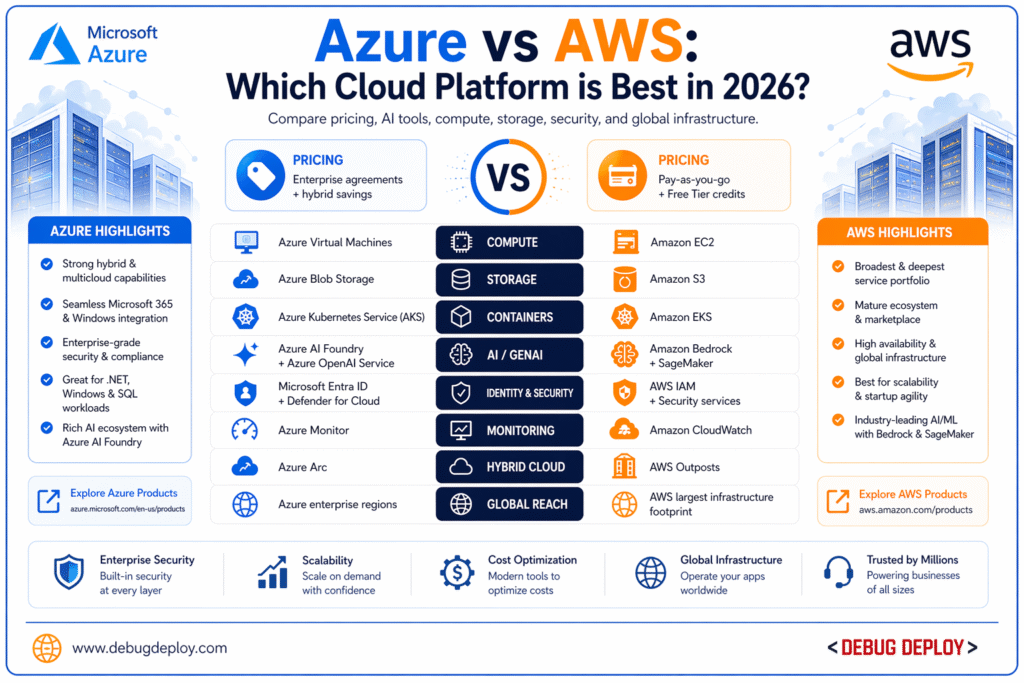
Comparison Table
Feature | AWS | Azure |
Market Position | Leader | Strong #2 |
Ease of Learning | Moderate | Easy |
Services | Extensive | Growing |
Pricing | Complex | Competitive |
Hybrid Cloud | Limited | Strong |
People Also Ask(FAQ's)
Which is better, Azure or AWS?
It depends on your career goals—Azure for enterprise roles, AWS for broader global opportunities.
Is Azure easier than AWS?
Yes, Azure is generally considered more beginner-friendly.
Can I learn both Azure and AWS?
Yes, learning both increases your career opportunities.
Which cloud platform is in demand in 2026?
Both are in high demand, but AWS leads globally while Azure grows in enterprises.
Do I need coding for cloud computing?
Basic scripting helps, but many roles do not require advanced coding.
Real-World Example
Example Scenario
Goal: Deploy a scalable web application
- AWS → Flexible architecture with global reach
- Azure → Seamless integration with enterprise tools
Result: Both platforms deliver scalable cloud solutions
Related Reports
- How Power BI Drives Smarter Data-Driven Decisions
- Transitioning Your Data Workflow from Excel to Power BI
- What Is Microsoft Azure? 7 Powerful Reasons Beginners Should Care About Cloud Computing
- What Is Power BI? A Complete Beginner’s Guide (2026)
Conclusion
The choice between Azure vs AWS depends on your career goals, learning preference, and industry focus.
Final Takeaways
- AWS → Best for global exposure and service variety
- Azure → Best for beginners and enterprise environments
- Learning both provides maximum flexibility
Career Insight
In 2026, cloud professionals who understand multi-cloud environments will have a strong competitive advantage.
Want to Get Certified in Cloud Computing?
Get trained by a Microsoft Certified Trainer (MCT) and build in-demand skills in cloud platforms like Microsoft Azure.
Recommended Microsoft Azure training programs:
| Course Code | Course Title |
|---|---|
| AZ-900T00-A | Microsoft Azure Fundamentals |
| AZ-104T00-A | Microsoft Azure Administrator |
| AZ-305T00-A | Designing Microsoft Azure Infrastructure Solutions |
✅ Live Instructor-Led Training
✅ Hands-On Cloud Labs
✅ Real-World Azure vs AWS Use Cases
✅ Architecture, Security & Networking Concepts
✅ Certification Exam Guidance
📧 Email us: trainings@debugdeploy.com
📱 WhatsApp us for quick assistance
Start your cloud certification journey today and become a skilled cloud professional in 2026!